Tag Archive for: Mobility

Speed Wins: How Global Platforms Capture Growth

Uber, Bolt, and Freenow do not win because they are popular. They win because they are fast.


Europe’s taxi and ride-hailing market is growing 10–15% each year. The key question is who will drive this growth. The answer lies in speed.

Operators that improve driver onboarding, pricing, driver tools, and support in weeks, not months, gain market share. Customer expectations change after every small improvement. If you respond a quarter later, you are already behind. 

Many local operators wait. They wait for industry groups, for the regulator, or for the “right moment.” This delay gives faster companies the advantage. Local firms then end up paying to use the very platforms they hoped to beat. 

A shift in how fast things move

In 2025, changes at Freenow under Lyft showed what fast execution looks like. The apps started to work together more closely for travelers between regions, promotions appeared quickly, and a refreshed brand emerged. Integration rolled out fast. 

There is a broader lesson from German industry as well. Slow, committee-based decisions can hurt speed. Look at Audi’s work with SAIC in China: a joint platform aimed at cutting time-to-market by more than 30%, with the first new model arriving in 2025. When competitors move faster, incumbents must shorten their cycles or lose ground. 

The practical lesson for DACH’s taxi industry

The winners build for the rulebook and still move quickly. They run on a fixed, short cycle and ship on schedule. Every two weeks, something is faster, clearer, or more reliable, and it shows up in acceptance rates, pickup times, and first-contact resolution. They also control their own platform.

With eCabs Technologies, operators own the brand, the rider and driver data, the pricing rules, and the roadmap. You are not renting a global marketplace; you are running your own service with local control, local compliance, and a product that adapts to your city.

How we apply this

At eCabs Technologies, we build with an operator’s mindset and a steady release cadence that fits European realities. In Malta, eCabs competes daily with Uber and Bolt by moving fast. Software ships often. The brand is refreshed when expectations change. This combination of quick product cycles and timely brand work keeps us competitive with every trip. 

Platforms do not win because they are popular. They win because they are fast. With the market growing 10–15% each year, the operators who move faster, and those who own their platform, will capture said growth. 

Europe’s Ride-Hailing Crossroads: Will We Build or Be Bought?

SaaS is the new infrastructure, and Europe’s future depends on who owns it.


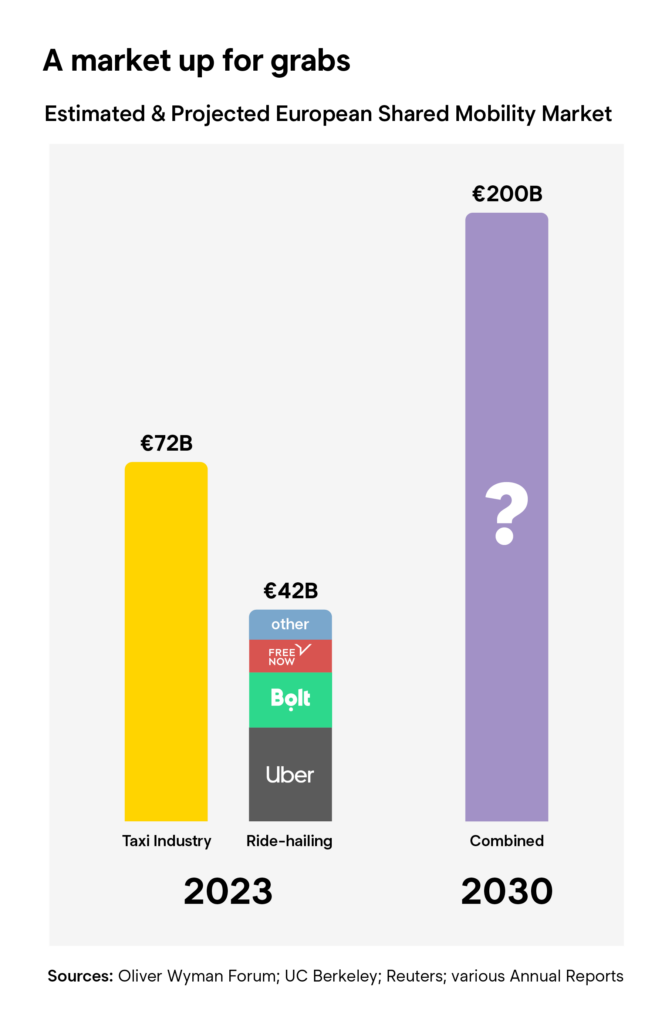
Europe’s streets are changing, fast. The way people move through cities, from airport runs to everyday commutes, is increasingly dictated by the swipe of an app. With the European ride-hailing and taxi industry forecast to reach €200 billion by 2030, and growing at a strong 10 to 15 percent annually, the opportunity is nothing short of transformative.

But so far, the biggest winners of this transformation are not European.

Across the continent, American platforms dominate. Uber is embedded in nearly every major city. Lyft, through its acquisition of Free Now, controls a significant share of the market in Germany, and beyond. These companies did not just compete; they scaled faster, lobbied harder, and positioned themselves as indispensable infrastructure.

A Market Europe Forgot to Own

It is not that Europe lacked the ingredients to lead. It still has them: world-class cities, high urban density, and a deep-rooted public mandate for sustainable, efficient transport. What has often been missing is a unified digital infrastructure and the boldness to think and scale like global tech platforms.

One notable exception is Estonia’s Bolt, the only major European ride-hailing platform operating at scale. Its resilience is a blueprint for what is possible when European innovation meets execution.

Elsewhere, fragmentation and inaction have left traditional operators exposed. Perhaps the most symbolic moment came in 2020, when Uber acquired UK-based Autocab, once a neutral SaaS provider powering thousands of local taxi firms. The same disruptor that once sought to replace taxi services now powers the software many of them rely on. Infrastructure, once neutral, has become strategic.

The Real Battleground: Software

The next chapter of this industry will not be decided solely by consumer-facing brands, but by who controls the Software-as-a-Service (SaaS) layer, the digital infrastructure behind every booking, dispatch, and payment.

This model protects driver livelihoods, restores regulatory balance, and reinforces data sovereignty, giving cities control over their mobility ecosystems. It is also a statement of European intelligence and leadership, proving that we can build scalable infrastructure aligned with local interests – not outsourced to foreign platforms.

This is where Europe still has a real opportunity to lead.

Companies like eCabs Technologies, based in Malta, are quietly building the software stack that enables local ride-hailing and taxi operators to digitise, compete, and scale without surrendering their independence. By offering white-label platforms tailored to local needs, they are helping cities and entrepreneurs take back control of their mobility ecosystems.

This model protects driver livelihoods, strengthens regulatory alignment, and ensures that Europe’s ride-hailing future is shaped by local intelligence and leadership, not just foreign balance sheets.

A Market Accelerating in Our Favour

Encouragingly, the macro tailwinds are undeniable.

  • Urbanisation is increasing, concentrating demand for fast, flexible transport. 
  • Younger generations prefer access over ownership and are far more likely to hail a ride than buy a car. 
  • Cultural shifts toward sustainability, flexibility, and digital convenience are driving long-term behavioural change.
  • Europe’s aging population is creating new, structural demand for accessible, on-demand mobility. 

This is not a passing trend. It is a generational reset in how Europe moves.

A Call to Build

The question now is whether Europe chooses to own this transformation or simply participate in it as a customer.

The industry is growing. The infrastructure is taking shape. The market is wide open. But unless Europe builds and backs its own champions, especially at the software layer, it risks trading one dependency for another.

As the EU debates digital sovereignty in cloud, AI, and semiconductors, mobility must not be left out. Ride-hailing is more than transport. It is infrastructure, and infrastructure is power.

With a €200 billion prize on the horizon, powerful demographic tailwinds, and the technological capability in place, the time for European leadership is now.

Because the real question is not who is in the driver’s seat today.
It is who is building the engine for tomorrow?


By Matthew Bezzina, eCabs Technologies’ CEO

The Urban Mobility Gold Rush

In the race for urban mobility dominance, local players and tech giants alike are staking their claim. Who will strike digital gold?


In the bustling cityscape of 2025, a modern-day gold rush is underway. But instead of pickaxes and pans, the tools of choice are smartphones and algorithms. From seasoned taxi operators to nimble startups, everyone’s racing to stake their claim in the app-driven mobility market. The price? A share of the global ride-hailing market projected to reach €200 billion by 2030

The New Urban Frontier 

The urban transportation landscape of 2025 is a far cry from the simple point A to point B journeys of yesteryear. Today’s commuters demand convenience, sustainability, and seamless user experiences. Ride-hailing apps have set new standards, offering features like real-time tracking, cashless payments, and dynamic pricing that have left traditional operators scrambling to keep up. 

As cities grapple with congestion and emissions, app-based services have become the new sheriffs in town, integral to modern urban planning. This shift has created a gold rush mentality, with smaller players seeing an opportunity to strike it rich by launching their own tailored apps. 

Competing with the Giants 

The urban mobility landscape is dominated by tech giants like Uber, Bolt, and Lyft. These behemoths have set the standard for ride-hailing services, but their global approach often leads to frustration for local players looking to compete. New market entrants are no longer satisfied with basic dispatch solutions; instead, they seek a more comprehensive product with advanced features that give them a fighting chance. They are looking for full-fledged ride-hailing apps that can rival the features and user experience offered by the industry leaders. 

This growing demand for powerful, feature-rich ride-hailing solutions is exactly where eCabs Technologies stands out. Unlike generalist tech companies, eCabs Tech has focused solely on building a state-of-the-art ride-hailing platform. By leveraging the combined expertise of our tech team and expansion specialists, we have created a solution that allows local operators to compete on an equal footing with global giants. 

Why Everyone’s Joining the App Rush 

  1. Staking Their Claim: Traditional taxi operators are tired of playing second fiddle to global platforms. By launching their own apps, they can plant their flag, set fair prices, and build their brand identity. 
  2. Local Knowledge is King: Unlike global giants, local operators understand their community’s unique needs and can offer tailored services that address specific regional concerns. For example, eCabs Malta introduced the “Woman+” category, allowing female passengers to select female drivers, enhancing safety and comfort for women riders, and the “Malti+” category specifically for Maltese-speaking drivers and passengers. 
  3. The Mother Lode: With the ride-hailing market set to hit €200 billion by 2030, even a small claim can yield a fortune. 
  4. Government Backing: Some regions are offering tax breaks or exclusive access to certain areas for homegrown solutions, akin to land grants in the old gold rush days. 
  5. Tools of the Trade: Developing an app is no longer like panning for gold with bare hands. White-label solutions and app development platforms have made it easier than ever for businesses to launch their own branded apps. 

Striking Digital Gold Isn’t Easy 

While the potential rewards are glittering, launching an app comes with its own set of challenges: 

  • Technical Expertise: Building a robust, user-friendly app requires specialised skills. 
  • Market Competition: The field is crowded, and standing out requires a clear value proposition. 
  • Operational Complexity: Managing a digital platform is akin to running a complex mining operation. 
  • Customer Acquisition: Attracting users in a saturated market demands smart prospecting strategies. 

This is where companies like eCabs Technologies come in, offering the modern-day mining equipment and expertise needed to succeed. 

eCabs Technologies: Your Partner in the Digital Gold Rush 

In this new frontier, eCabs Technologies emerges as a crucial ally, providing not just the tools but also the expertise to navigate the complex terrain of app-driven mobility. Our offering goes beyond mere app development, encompassing a comprehensive suite of services designed to help businesses strike gold in the digital mobility landscape. 

What sets eCabs Technologies apart is our Growth & Expansion department acting as experienced prospectors guiding businesses through every step of their journey: 

  • Strategic Planning: Developing competitive strategies to help businesses stand out in the market and compete effectively with industry leaders. 
  • Operational Guidance: Providing insights on fleet management, driver onboarding, and operational efficiency. 
  • Marketing Expertise: Crafting strategies to attract users and build brand loyalty in a competitive market. 
  • Continuous Improvement: Offering ongoing support to refine operations and maximise success post-launch. 

The value of this “handholding” approach cannot be overstated. For many partners, particularly traditional taxi operators, transitioning from conventional operations to a tech-driven model can be as daunting as venturing into uncharted territory. eCabs Technologies’ Growth & Expansion team provides the steady guidance needed to navigate this new landscape successfully, offering not just technology but also the strategic expertise to use it effectively. 

The Future of Urban Mobility 

As urban mobility continues to evolve, the app gold rush will only intensify. For businesses willing to adapt, invest and innovate, the opportunities are as vast as the unexplored territories of old. With the right technology partner and strategic guidance, it is possible not just to compete with giants but to carve out a thriving business in this new landscape. 

In this gold rush, the real winners aren’t just those who move people, but those who move fast, think smart, and partner wisely. With a skilled ally in eCabs Technologies, ambition can indeed be translated into success. 


By Molka Sfar, Growth and Expansion Manager

The End of the Ride-Hailing Price Dumping Binge

As ride-hailing giants face mounting financial pressure, the era of artificially low fares is ending – forcing the industry to confront a new economic reality.


For over a decade, venture-funded ride-hailing firms have relied on a single, aggressive strategy: deploy vast amounts of investor capital to subsidise fares, artificially inflate driver earnings, and rapidly acquire market share. This approach allowed companies such as Uber and Bolt to upend local transport markets, setting pricing expectations that bore little resemblance to economic reality. 

But the landscape is shifting. With capital markets tightening and profitability becoming the key measure of success, the sustainability of this model is under increasing scrutiny. Uber has already embarked on a path of financial discipline, gradually reducing incentives to stabilise its balance sheet. Bolt, by contrast, remains heavily reliant on subsidisation  though its forthcoming IPO will almost certainly force it into a similar transition. 

A Financial Model Addicted to Subsidies 

The numbers lay bare the extent of Bolt’s dependency on subsidies. In 2023, the company reported €1.7 billion in revenue, yet €535.7 million (nearly a third) was allocated to rider and driver incentives. The previous year, subsidies were even higher at €537.9 million, despite total revenue being just €1.24 billion. This is not the profile of a business growing on strong fundamentals, but one that remains reliant on continuous financial injections to sustain user engagement. 

Malta: A Case Study in Subsidy Withdrawal 

The impact of this model is particularly visible in Malta, a microcosm of Bolt’s wider European strategy. For months, the company has subsidised up to 75% of completed rides, distorting pricing dynamics and exerting immense pressure on competitors. Last week, however, Bolt briefly scaled back discounts to 25%, prompting an immediate 30–40% surge in competitor ride volumes. This week, in an attempt to counteract the shift, it reversed course, increasing subsidies once again to cover 50% of the market – a clear indication of its ongoing struggle to maintain dominance without aggressive price manipulation. 

More significant than these short-term fluctuations is the broader trend taking shape. Each time Bolt pulls back on subsidies, the market reacts, allowing local operators such as eCabs Malta to reclaim ground. This is a live demonstration of what happens when ride-hailing giants are forced to compete under real financial constraints. For years, their capital war chest allowed them to dictate the terms of competition. Now, as the pressure to rein in losses grows, the inherent financial resilience of local operators who have always been required to run commercially viable businesses becomes increasingly relevant. 

Uber’s Rehabilitation, Bolt’s Impending Reckoning 

Uber, recognising the shifting economic climate, has taken steps to extricate itself from its reliance on subsidies. The transition has been gradual, but necessary. Growth has slowed, fare prices have adjusted upwards, and the company is now focused on building a sustainable profit model. 

Bolt, however, has yet to take the same corrective measures. The firm remains dependent on deep discounts to retain market share, delaying the inevitable reckoning that will come with its public listing. Once under the scrutiny of public investors, Bolt will face the same market pressures that forced Uber into financial sobriety. At that point, price cuts will no longer be a luxury but an unsustainable liability. 

A More Balanced Market on the Horizon

For the legacy taxi and private hire vehicle (PHV) operators who have endured more than a decade of artificial market distortions, the outlook is beginning to improve. With ride-hailing firms now under pressure to operate on commercially viable terms, competition is shifting back to factors such as service reliability, operational efficiency, and brand trust areas where long-standing operators have inherent advantages. 

Moreover, these operators are no strangers to survival in tough conditions. The COVID-19 pandemic and years of relentless competition from global ride-hailing giants have forced them to become lean organisations – capable of running marathons with very limited oxygen levels. Their ability to operate efficiently, without the crutch of venture capital, means they are better equipped to compete in a world where price dumping is no longer a sustainable strategy. 

The coming years will mark a new phase in the ride-hailing industry. Those that can adapt to financial reality will survive. Those that cannot will face an unavoidable correction. The era of unchecked subsidies is ending, and with it, a more balanced and sustainable market is set to emerge. 


By Matthew Bezzina, eCabs Technologies’ CEO

Drink-driving crackdown exposes Italy’s need for transport innovation

Italy needs to embrace the tech revolution to improve its transport options


A recent drink-driving crackdown in Italy has exposed how the country’s outdated taxi system needs to embrace new tech.   

A few weeks ago, the Italian government rolled out massive fines aimed at tackling drink-driving.  

While the harsh penalties—up to €6,000 per driver—proved effective in curbing drink-driving over the festive season, it also shined a spotlight on the lack of viable alternative transport options in cities across the country.

A broken taxi system

At the heart of the problem is an overly protected taxi sector.

Italy’s taxi industry remains one of Europe’s most restricted markets. Its licensing system caps the number of taxis, creating an artificial scarcity that drives up costs and limits availability.

As a result, finding a taxi in major cities has become a nightmare; getting around after midnight—especially during peaks in demand—is almost impossible.

Reports in leading Italian media in recent weeks speak of residents stranded at night, forced to walk home, or resort to even riskier alternatives.

From Florence to Rome, restaurants, bars, and clubs complain about how the new harsh anti drink-driving measures have left them with empty tables or slimmer margins as diners become increasingly cautious.

Tourists unfamiliar with local systems fare even worse, navigating a system that’s outdated and far removed from their expectations and needs.

For a nation hosting an average of 60 million tourists annually, this is more than a mere inconvenience—it’s an economic liability.

Put plainly, the fact that Italy’s transport infrastructure struggles to handle demand surges tarnishes its global reputation as a premier destination.

The need for disruption

The Italian taxi and Noleggio con Conducentesector (NCC) sectors urgently require innovation.

A new wave of entrepreneurial energy, paired with technology, could transform what has long been a stagnant market.

Platforms like eCabs Technologies demonstrate the potential of digital solutions—from dynamic pricing engines tailored to demand, to seamless integration with legacy systems.

Technology can indeed modernise the sector, creating a responsive, efficient, and customer-focused ecosystem. It’s time to move beyond regulation as the primary tool and embrace digital transformation to unlock Italy’s night-time economy.

As Italy grapples with these challenges, the path forward is clear: invest in technology, support innovative platforms, and enable entrepreneurial ventures.

By modernising its taxi and NCC offerings, Italy can not only meet its mobility and safety needs but also reinvigorate its economy, ensuring that both residents and tourists thrive.

Today, eCabs Technologies powers successful ride-hailing operations in Malta, as well as Athens, Greece, and Bucharest, Romania, with several other European jurisdictions going live in 2025. 

With more than 450 employees and a quarter of a million rides completed monthly, the company has undergone considerable growth. 

Find more information on how eCabs Technologies is leading the digital revolution for the shared mobility industry across Europe here.


By Matthew Bezzina, eCabs Technologies’ CEO

Guida in stato di ebbrezza: l’Italia ha bisogno di innovazione nei trasporti

L’Italia deve abbracciare la rivoluzione tecnologica per migliorare le sue opzioni di trasporto. 


Una recente stretta sulla guida in stato di ebbrezza in Italia ha messo in luce come il sistema di taxi obsoleto del paese debba evolversi e adottare nuove tecnologie. 

Alcune settimane fa, il governo italiano ha introdotto multe salatissime per combattere la guida in stato di ebbrezza. 

Sebbene le severe sanzioni—fino a €6.000 per conducente—siano state efficaci nel ridurre i casi di guida in stato di ebbrezza durante le festività, hanno anche evidenziato la mancanza di opzioni di trasporto alternative valide nelle città di tutto il paese.

Un sistema di taxi inefficiente

Al centro del problema c’è un settore dei taxi eccessivamente protetto. 

L’industria dei taxi in Italia rimane uno dei mercati più regolamentati d’Europa. Il sistema di licenze limita il numero di taxi, creando una scarsità artificiale che aumenta i costi e riduce la disponibilità. 

Di conseguenza, trovare un taxi nelle principali città è diventato un incubo; spostarsi dopo la mezzanotte—soprattutto durante i picchi di domanda—è quasi impossibile. 

Recenti articoli nei principali media italiani riportano storie di residenti bloccati di notte, costretti a tornare a casa a piedi o a ricorrere ad alternative ancora più rischiose. 

Da Firenze a Roma, ristoranti, bar e locali notturni si lamentano che le nuove e rigide misure contro la guida in stato di ebbrezza abbiano lasciato loro tavoli vuoti e margini di guadagno più ridotti, mentre i clienti diventano sempre più prudenti. 

I turisti, poco familiari con i sistemi locali, se la passano anche peggio, alle prese con un sistema obsoleto e lontano dalle loro aspettative e necessità. 

Per una nazione che ospita una media di 60 milioni di turisti all’anno, questo rappresenta più di un semplice inconveniente: è una vera e propria minaccia economica. 

In parole semplici, il fatto che l’infrastruttura dei trasporti in Italia non riesca a gestire i picchi di domanda danneggia la sua reputazione globale come destinazione di eccellenza. 

La necessità di una rivoluzione 

I settori dei taxi e del noleggio con conducente (NCC) in Italia necessitano urgentemente di innovazione. 

Una nuova ondata di energia imprenditoriale, unita alla tecnologia, potrebbe trasformare un mercato che da troppo tempo è stagnante. 

Piattaforme come eCabs Technologies dimostrano il potenziale delle soluzioni digitali—da motori di prezzi dinamici adattati alla domanda, a integrazioni fluide con i sistemi tradizionali. 

La tecnologia può davvero modernizzare il settore, creando un ecosistema reattivo, efficiente e incentrato sul cliente. È tempo di andare oltre la regolamentazione come strumento principale e abbracciare la trasformazione digitale per sbloccare il potenziale economico della notte in Italia. 

Mentre l’Italia affronta queste sfide, la strada da seguire è chiara: investire nella tecnologia, supportare piattaforme innovative e favorire le iniziative imprenditoriali. 

Modernizzando l’offerta di taxi e NCC, l’Italia non solo potrà soddisfare le sue esigenze di mobilità e sicurezza, ma anche rivitalizzare la sua economia, garantendo un futuro sia per residenti che per turisti. 

Oggi, eCabs Technologies alimenta operazioni di ride-hailing di successo a Malta, così come ad Atene, in Grecia, e a Bucarest, in Romania, con altre giurisdizioni europee pronte al lancio nel 2025. 

Con oltre 450 dipendenti e un quarto di milione di corse completate ogni mese, l’azienda ha registrato una crescita significativa. 

Scopri di più su come eCabs Technologies sta guidando la rivoluzione digitale per l’industria della mobilità condivisa in tutta Europa qui.


Di Matthew Bezzina, CEO di eCabs Technologies

Europe’s shared mobility market is growing 20% annually, to reach €200 billion by 2030 – Uber and co. want it all

How will legacy operators fight back?


If you operate a taxi business or association today, this is what the likes of Uber and other ride-hailing giants don’t want you to know: the combined taxi and ride-hailing sectors are growing 20% every single year. And, by 2030, Europe’s shared mobility market is projected to generate €200 billion in annual revenues.

But, while legacy operators are dreaming of market share and margins of yesteryear, ride-hailing giants are growing faster than you think.

These Trojan Horses are silently sneaking into cities across Europe – luring drivers and taxi operators with promises of ‘low commissions’ and ‘platform partnerships’.

But what they are really doing is robbing legacy operators of everything they have worked so hard to build.

Traditionally, the shared mobility market has been anchored by taxi businesses and associations-regulated, for-hire chauffeured vehicles available through curbside hail, pre-booking, or dispatch. These businesses were and remain the backbone of this sector. If you run one of these operations today, do not make the mistake of believing you are the underdog. Because this is not a David vs Goliath story – not quite.

Sure, many of these large ride-hailing platforms can draw on billions in investor funding, but legacy operators still make up about half of Europe’s shared mobility sector. And, more importantly, you have something that these new rivals don’t. Legacy operators have built fleets of loyal and trustworthy drivers – something platforms need to spend big on to try and win over.

You also have deeply ingrained brand recognition, in some cases built over decades if not even generations. And most of you operate in regulatory environments that were designed around you and your needs.

The Ubers of this world on the other hand? They will do whatever it takes to steal your driver supply. They will weaponise their sleek apps to dazzle riders too. They will deploy sweeping, glitzy marketing and social media campaigns. They will even engage in product placement with streaming services like Netflix, targeting the GenZ and GenAlpha riders and drivers of tomorrow.

All the while, they will bully regulators into redesigning policy frameworks to work for them, and – if possible – against you.

These platforms don’t want a slice – they’re after the whole pie.

Embracing the future

Every year, ride-hailing’s share of the European mobility market grows. And, although traditional operators still have an edge, their life expectancy will hinge on their willingness to adapt to new realities. The past is over. The mobility market of the early 2010s cannot be recreated.

Today, more than ever before, it has become essential for taxi operators to embrace emerging technology. Younger generations expect seamless, user-friendly, app-based experiences. They expect this and just won’t settle for less.

Meanwhile, as car ownership declines and urbanisation continues to rise, the demand for efficient shared mobility solutions will only continue to grow.

Countries are also looking inward for innovation, particularly as the trend of hyper-globalisation has hit the brakes. This, again, presents a significant opportunity for homegrown disruption, allowing local operators to innovate and adapt to meet the specific needs of their communities.

A lot is changing. The opportunity to go after this €200 billion market is wide open.

It’s time for legacy operators to fight fire with fire – to become the innovators leading the future of shared mobility. But to do this, they need to invest in the future – in cutting-edge technology, operational horsepower, and industry-leading talent. You can do all this while still holding on to your brand, your autonomy, and without having to hand over the steering wheel.

The industry is growing. Are you?


By Matthew Bezzina, eCabs Technologies’ CEO

eCabs joins EU-wide Taxis 4 Smart Mobility coalition

Pictured: eCabs Technologies’ CEO, Matthew Bezzina (left), and Director of Marketing, Erik Polus.

The group is the leading voice for a sustainable European taxi industry

eCabs Malta has announced it has become a member of the Taxis 4 Smart Mobility coalition, a network of innovative and socially responsible taxi organisations.

T4SM represents the European taxi industry, advocating for sustainable, smart mobility solutions while ensuring local and national regulations reflect the unique needs of communities—whether in small villages or large cities. With members from Austria, Denmark, France, Germany, the Netherlands, and Switzerland, the coalition brings thorough insight into the continent’s taxi sector.

eCabs Founder Matthew Bezzina said he was excited to join a group that is made up of some of the leading operators in Europe to lobby for a more sustainable industry.   

“Joining Taxis 4 Smart Mobility is a natural next step for eCabs, aligning perfectly with our vision for a future where mobility is seamless, sustainable, and technology-driven,” Bezzina said.

“We are committed to playing our part in fostering a smart mobility ecosystem that not only meets the needs of riders and drivers but also contributes positively to the environment and communities in which we operate. That’s because we truly believe that this industry can be a major part of the solution,” he added. 

Coalition Chairperson Gregor Beiner said eCabs was a welcome addition to the Taxis 4 Smart Mobility group. 

“eCabs Malta brings another important and dynamic perspective to the coalition with its innovative approach to smart mobility and deep-rooted commitment to sustainability. We are delighted that they are joining T4SM. We will continue to work together on a sustainable and stable mobility offer for Europe and have gained another important partner in eCabs Malta,” Beiner said.

Bezzina and eCabs Director of Marketing, Erik Polus, will attend the coalition’s upcoming meeting in November, shortly after the European Commission hearings are held in Brussels.

This meeting will discuss how the taxi sector can further contribute to the European Green Deal and the ambitious targets set for reducing carbon emissions by 2030.

The Taxis 4 Smart Mobility coalition’s mission is to ensure that the taxi industry leads by example in sustainable urban transport, contributing to the reduction of emissions and traffic congestion, and enhancing accessibility for all.

Through lobbying efforts and collaboration with policymakers, the coalition pushes for more supportive regulatory frameworks and investment in technologies that can transform the industry.

The eCabs announcement comes after Bezzina was among the international speakers at Europe’s leading taxi and transport conference earlier this year.

The European Radio Taxi Association conference brings together prominent figures from the taxi and transport industry across Europe, providing a platform for sharing insights, discussing challenges, and exploring the future of urban mobility.

Speaking during the ERTA conference, held in Düzce, Turkey, Bezzina recalled the eCabs journey over the years.

As a bootstrapped start-up successfully competing with global brands across several EU markets, eCabs has transitioned from a small traditional taxi operator to an app developer empowering fellow operators across Europe to successfully compete against global ride-hailing brands like Bolt and Uber. 

eCabs Technologies, the tech arm of the group, is responsible for developing the proprietary technology that powers the eCabs platform in Malta as well as other ride-hailing operations across Europe. 

New ride-hailing ventures in Bucharest, Romania, and Athens, Greece were launched earlier this year, with projects in other jurisdictions set to launch in the coming months. 

Meanwhile, with his extensive background in marketing and growth, having previously been engaged at Beat (part of FreeNow), Erik Polus said eCabs Technologies is on a mission to empower the taxi industry to successfully compete in the digital age.

“eCabs Technologies has a scalable and competitive ride-hailing tech offering, including rider and driver apps, and a suite of tools for operators, fleet owners, and company managers,” he said.

“We can safely say our solution is proven to be scalable and competitive as we use our tech stack every day to run our business in Malta, a business which includes one of the largest owned and operated fleets in the country, as well as thousands of partner drivers, and a 24/7 call and booking centre.”

“We have built the tools and developed the industry knowledge to partner with businesses that are seeking to not only survive but to thrive against ride-hailing giants,” he said. 


In the Press: Times of Malta | Malta Today | The Malta Independent


The innovator’s dilemma: Legacy taxi operators vs Uber

The last of the taxi roof lights are flickering out, and their once-buzzing dispatchers’ radios are falling silent. Across Europe and beyond, long-standing legacy taxi operations face a formidable challenger: ride-hailing applications like Bolt and Uber are sweeping through every market, in every jurisdiction, gobbling up riders and drivers alike.

Contrary to what you might read elsewhere, legacy taxi businesses do not face an uncertain future. They face a clear and inevitable reality: ride-hailing is here to stay. The critical question as the rides industry continues to grow year-on-year is not if traditional taxi businesses will survive but who will take the largest slice of the pie: disruptors or traditional operators?

The dangers of complacency

Fifteen years ago, eCabs was born as a traditional dial-a-cab business. Like most legacy taxi businesses, we manually registered bookings and dispatched rides from our bookings office. I remember those days—passengers queuing outside our dispatch centre after a night out, drivers waiting idly for their turn to be called on the tannoy.

However, we founded eCabs with the intent to digitize our rides service. We built our own digital platform, on bare metal infrastructure, with all the complications that come with it. We’ve experienced the tricky transition from one system to another—patches upon patches, and late-night scrambling to get back online. All the while, we were competing against the largest ride-hailing platform in the region, Bolt.

Over the years, I’ve learned that disruption can come in pitter-patter, showers, or torrential downpours. In Malta, it was a deluge. After Bolt, came Uber. Today, eCabs is the only locally grown ride-hailing operation in its home market, with other businesses in different jurisdictions running on our platform. This success stems from our continuous investment in our digital offering, from partnering with global leaders like the Google Maps Mobility Platform to headhunting talent from leading ride-hailing tech players.

Facing the real threat

What we’ve learned is that the greatest threat traditional taxi businesses face today isn’t innovation and disruption; it’s the temptation to ignore transformative change. The danger is in burying heads in the sand, hoping ride-hailing tech will simply go away. Take it from me—it won’t. These giants are coming for the traditional taxi businesses, and the answer isn’t in ignoring the change but embracing it.

Legacy operators must become disruptors themselves if they want to survive. Harvard Business School professor Clayton Christensen introduced the concept of the Innovator’s Dilemma in 1997, explaining how established companies often focus on sustaining innovations—incremental improvements to existing products—at the expense of recognizing disruptive innovations on the horizon. These major changes may initially serve niche markets, but they have the power to redefine entire industries.

For legacy taxi businesses, the disruption came in the form of ride-hailing apps. Ignoring these innovations is a recipe for obsolescence. As Uber’s own CEO Dara Khosrowshahi said nearly seven years ago: “If you don’t disrupt yourself, someone else will.”

How to fight back

Digital transformation isn’t a button you press; it’s a process. What eCabs has developed isn’t just a white-label patch for legacy businesses trying to add a digital component to their service. We’ve packed 15 years of hands-on industry expertise into a platform built from real-world experience—competing against global ride-hailing giants, managing fleets, developing data-driven rider marketing campaigns, and educating policymakers.

This isn’t a first aid kit for traditional businesses; it’s a journey for operators who want to become regional leaders in mobility. Because make no mistake, global ride-hailing platforms aren’t coming for a piece of the pie—they want the entire thing.


By Matthew Bezzina, eCabs Technologies CEO


Matthew Bezzina will be a key speaker at the upcoming Start-Up Festival in Malta. The festival brings together entrepreneurs, investors, and enthusiasts to explore cutting-edge technologies, disruptive business models, and groundbreaking solutions. A highlight is the “Dream Big Malta” panel, celebrating the achievements of individuals from Malta excelling in international business, professions, or sports.

The original article may be found here.

To sell or not to sell – that is the question

eCabs Technologies’ commitment to a solution-oriented sales approach has been one of the driving forces behind its success. 

eCabs Technologies: A product-oriented approach to success

The ride-hailing industry is a crowded space, filled with giants vying for your attention.

At eCabs Technologies , we understand that simply offering another product isn’t enough.

We are not just here to sell you software. We’re here to work with you, and provide you with our market-leading solution born from our cutting-edge ‘mobility laboratory‘.

But what truly sets us apart?

We don’t just sell, we partner. Instead of bombarding you with generic sales pitches, we take a solution-oriented approach.

This means we dive deep into your specific needs and challenges.

We become an extension of your team, understanding your business from the inside out.

Embracing a solution-oriented mindset

Our cutting-edge mobility laboratory isn’t just a fancy term. It’s a hub of innovation where we continuously refine and perfect our platform to stay ahead of the curve.

This ensures that when you partner with eCabs Technologies, you’re not just getting a solution. You’re getting a platform built for the future, playbooks on how to operate your business, alongside our 14 years of operational experience.

We’re perfectly attuned to the dynamic needs of the ride-hailing market.

But here’s the best part: we don’t believe in a one-size-fits-all approach. We have designed our platform to be customisable, allowing us to seamlessly adapt it to your unique business goals and challenges.

Your success is our success. And we’re committed to providing you with the tools and support you need to thrive in the ever-evolving ride-hailing landscape.

Beyond structured meetings: building genuine connections 

We understand that building genuine relationships goes beyond formal sales meetings. 

We actively seek out opportunities to engage with potential clients in informal settings, fostering a sense of connection and trust. 

While we are based in Malta, which has become a proven testbed for mobility products, our city partners are based in mainland Europe.

For us this means that we’re constantly educating, advocating and championing mobility through digital channels.

Nurturing genuine relationships, through channels such as LinkedIn, is critical in ensuring that we can continuously share our findings and learnings in the mobility industry and guide potential city partners to the right solution.

Delving into the client’s world 

eCabs Technologies goes beyond superficial understanding; we strive to gain a deep appreciation of our partners’ businesses. 

Proper exploration, and applying the appropriate framework is imperative, to ensure that we can accurately map out your requirements and align them to our solutions.

Additionally, studying our partners’ operations, understanding their unique context, and being able empathise with the challenges they face. 

By becoming intimately acquainted with our City Partners’ business through on-site visits, we can tailor solutions that are truly aligned with their goals and objectives. 

The power of knowledge transfer 

We recognise the value of education and knowledge sharing in building trust and establishing credibility. 

We actively educate potential clients about the ride-hailing industry, highlighting industry trends, best practices, and the latest technology advancements.

When we launch in a city, we share a refined launch ‘Playbook’ with our City Partners, to ensure a successful launch from the get-go.

Our knowledge transfer goes beyond the ride-hailing platform and the operations.

The eCabs Technologies Expansion Team will guide you weekly on the industry fundamentals, and emerging trends, and take on product feedback. In the background, we continue iterating on our products to ensure that our partners can stay ahead of the curve in any city that they choose to operate in.

This comes from our over 14 years of experience, from operations through to software development.

By equipping you with the knowledge and insights to make industry-informed business decisions, we go beyond offering software.

eCabs Technologies, as your partner in innovation, leverages our cutting-edge ‘mobility laboratory’ to tailor solutions that empower your success.

We believe in your journey to success, and we’re here to support you every step of the way.

The proof of our expertise 

eCabs Technologies’ success is not just talk. It is backed by our partners and case studies. These demonstrate the tangible impact of our software platform on client businesses. 

From enhancing operational efficiency and customer satisfaction to driving profitability and expanding market reach, the features within eCabs’ ride-hailing solution have proven their value across a diverse range of industries and clients – enabling a ride-hailing operator to take on more than just dial-a-cab bookings.

In addition to our commitment to your success with eCabs, our ride-hailing solution is a scalable and adaptable platform without upfront software costs.

Case study: eCabs Technologies and Malta’s taxi industry 

In Malta, eCabs has played a pivotal role in transforming the taxi industry since 2010. 

By understanding the specific needs of local taxi drivers and operators, and taking on national stakeholder feedback, it developed a software platform that streamlined operations, enhanced customer satisfaction, and boosted profitability across the board. 

This success has earned eCabs Technologies a reputation as a trusted partner in Malta’s ride-hailing landscape. 

Our solution-oriented approach has proven to be a winning formula. Enabling our City Partners to build strong partnerships within their local communities and the European Union.

By prioritising understanding, knowledge transfer, and genuine connection, eCabs Technologies has established itself as a trusted advisor and a true solutions provider for the ride-hailing industry. 

Together, let’s not only shape the future of ride-hailing but also a sustainable future. eCabs Technologies is here to walk the talk and partner with you on your journey forward.