
Tag Archive for: technology

Europe’s Ride-Hailing Crossroads: Will We Build or Be Bought?

SaaS is the new infrastructure, and Europe’s future depends on who owns it.


Europe’s streets are changing, fast. The way people move through cities, from airport runs to everyday commutes, is increasingly dictated by the swipe of an app. With the European ride-hailing and taxi industry forecast to reach €200 billion by 2030, and growing at a strong 10 to 15 percent annually, the opportunity is nothing short of transformative.

But so far, the biggest winners of this transformation are not European.

Across the continent, American platforms dominate. Uber is embedded in nearly every major city. Lyft, through its acquisition of Free Now, controls a significant share of the market in Germany, and beyond. These companies did not just compete; they scaled faster, lobbied harder, and positioned themselves as indispensable infrastructure.

A Market Europe Forgot to Own

It is not that Europe lacked the ingredients to lead. It still has them: world-class cities, high urban density, and a deep-rooted public mandate for sustainable, efficient transport. What has often been missing is a unified digital infrastructure and the boldness to think and scale like global tech platforms.

One notable exception is Estonia’s Bolt, the only major European ride-hailing platform operating at scale. Its resilience is a blueprint for what is possible when European innovation meets execution.

Elsewhere, fragmentation and inaction have left traditional operators exposed. Perhaps the most symbolic moment came in 2020, when Uber acquired UK-based Autocab, once a neutral SaaS provider powering thousands of local taxi firms. The same disruptor that once sought to replace taxi services now powers the software many of them rely on. Infrastructure, once neutral, has become strategic.

The Real Battleground: Software

The next chapter of this industry will not be decided solely by consumer-facing brands, but by who controls the Software-as-a-Service (SaaS) layer, the digital infrastructure behind every booking, dispatch, and payment.

This model protects driver livelihoods, restores regulatory balance, and reinforces data sovereignty, giving cities control over their mobility ecosystems. It is also a statement of European intelligence and leadership, proving that we can build scalable infrastructure aligned with local interests – not outsourced to foreign platforms.

This is where Europe still has a real opportunity to lead.

Companies like eCabs Technologies, based in Malta, are quietly building the software stack that enables local ride-hailing and taxi operators to digitise, compete, and scale without surrendering their independence. By offering white-label platforms tailored to local needs, they are helping cities and entrepreneurs take back control of their mobility ecosystems.

This model protects driver livelihoods, strengthens regulatory alignment, and ensures that Europe’s ride-hailing future is shaped by local intelligence and leadership, not just foreign balance sheets.

A Market Accelerating in Our Favour

Encouragingly, the macro tailwinds are undeniable.

  • Urbanisation is increasing, concentrating demand for fast, flexible transport. 
  • Younger generations prefer access over ownership and are far more likely to hail a ride than buy a car. 
  • Cultural shifts toward sustainability, flexibility, and digital convenience are driving long-term behavioural change.
  • Europe’s aging population is creating new, structural demand for accessible, on-demand mobility. 

This is not a passing trend. It is a generational reset in how Europe moves.

A Call to Build

The question now is whether Europe chooses to own this transformation or simply participate in it as a customer.

The industry is growing. The infrastructure is taking shape. The market is wide open. But unless Europe builds and backs its own champions, especially at the software layer, it risks trading one dependency for another.

As the EU debates digital sovereignty in cloud, AI, and semiconductors, mobility must not be left out. Ride-hailing is more than transport. It is infrastructure, and infrastructure is power.

With a €200 billion prize on the horizon, powerful demographic tailwinds, and the technological capability in place, the time for European leadership is now.

Because the real question is not who is in the driver’s seat today.
It is who is building the engine for tomorrow?


By Matthew Bezzina, eCabs Technologies’ CEO

Modern Taxi Software Needs Modern Taxi Operators

Taxi software evolves quickly. The real challenge is evolving with it.


After a recent strategy session with one of Europe’s leading taxi operators, one thing became clear: the biggest hurdle to transformation is not just the software. It is the shift in mindset that must come with it.

Legacy taxi dispatch systems have real technical limits. They are slow, rigid, and were never designed to support today’s demands like real-time taxi booking apps, white label ride-hailing solutions, or scalable cab dispatch software. But even when better taxi software is available, many operators struggle to move forward. Not because the tools are not good enough, but because the organisation is not ready for what those tools require.

What Holds Back Transformation? 

Switching platforms is not just a tech upgrade. It is a business overhaul. You need to move data, retrain staff, rethink performance indicators, and shift the internal culture. You are not just replacing what you use. You are redefining how you work.

At eCabs Technologies, we have lived this process ourselves. Between 2017 and 2019, our operation in Malta went through its own digital reinvention. It was messy. It was hard. But it was necessary. And it laid the foundation for the platform we now offer to legacy taxi operators worldwide: a modern, modular, white label taxi app and dispatch system built for real operational complexity and scale.

Software Alone Is Not Enough

Digital transformation cannot be outsourced. The right taxi software matters, but so does the mindset behind it. That is why we do not just provide the technology. We act as a mobility technology and growth partner. We guide operators through the entire shift with strategic support, onboarding, and ongoing collaboration.

When the right software meets a prepared team, here is what becomes possible:

  • Real-time driver and fleet control 
  • Automated workflows that reduce dispatcher strain 
  • Passenger-facing taxi booking apps that feel as seamless as Uber or Bolt
  • Scalable models that allow operators to grow without rebuilding their infrastructure 

        The Cultural Challenge

        Legacy software slows you down. Legacy thinking stops you entirely. Transformation is not just about modernising your platform. It is about becoming an organisation ready to compete in a digital-first market. 

        Think of it not as replacing a system, but as creating a business that can thrive in a connected, data-driven environment. That is where the real work is. And that is where the real payoff comes from.

        What Comes Next

        Operators who adapt quickly are not just updating tools. They are rewriting their future. At eCabs Technologies, we support that journey from day one through to scale.

        Modern taxi software needs modern taxi operators. The question is: are you ready to lead?


        Matthew Bezzina at Meet-the-Cab 2025: Driving Taxi Industry Innovation

        A look at Matthew Bezzina’s insights on adapting to change, leveraging technology, and driving the future of the taxi industry at Meet-the-Cab 2025 in Vienna.


        At the Meet-the-Cab 2025 conference in Vienna, Matthew Bezzina, CEO of eCabs Technologies, delivered a compelling message to legacy taxi operators: the future belongs to those who embrace change and technology. Highlighting the stark reality facing the traditional taxi industry, Bezzina emphasised that competing with global ride-hailing giants requires more than just playing defense—it demands rapid evolution, smarter strategies, and a commitment to innovation.

        Bezzina shared the story of eCabs Technologies’ 15-year journey, transforming through technology, agility, and a hyper-localised, customer-centric approach. He illustrated the importance of adaptation by referencing the frog in the pan, which fails to react to gradual change, and the turtle, which has survived since the time of the dinosaurs through continuous adaptation. This metaphor underscored his key message: evolution is not optional for survival in today’s fast-paced industry.

        Meet-the-Cab 2025
        Photograph by Angelo Kreuzberger

        Representing both the technology and the operations behind Malta’s Private Hire sector at a traditionally taxi-focused event, Bezzina’s presence was a testament to the importance of open dialogue and collaboration across industry lines. Invited by Christian Holzhauser and Julia Schellnast from Taxi 40100, his participation highlighted a willingness to foster innovation and share strategies that drive the entire industry forward.

        Bezzina’s presentation highlighted how eCabs Technologies leverages cutting-edge technology for operational efficiency and customer satisfaction, while emphasising the need for industry-wide innovation. He detailed investments in digital platforms, AI-driven pricing, automated dispatch, and eco-friendly fleet solutions, urging legacy operators to rethink strategies and adopt modern tools. The Meet-the-Cab 2025 conference provided a vital platform for these discussions, leaving attendees with a clear message: to survive and thrive, the taxi industry must evolve swiftly, embrace technology, and remain agile in an ever-changing market landscape.


        By Matthew Bezzina, eCabs Technologies’ CEO

        How UX is Shaping the Future of European Ride-hailing

        eCabs Technologies’ UX/UI Designer Kristen Jim shares how seamless experiences move people and businesses forward.


        Ride-hailing apps have transformed the way we travel, making transportation more accessible, convenient, and efficient. In Malta, eCabs, Bolt, and Uber have made their mark, but the key to staying ahead in this competitive landscape is offering a seamless user experience (UX) that caters to the unique needs of both riders and drivers.

        At eCabs Technologies, our commitment to exceptional UX drives our operations in Malta and powers solutions in international markets such as Athens and Bucharest. Whether for eCabs Maltataxi.gr, or blue.ro, our approach combines a respect for proven methodologies with a relentless pursuit of improvement and innovation.

        Why Familiarity Matters in Ride-Hailing

        Users don’t want to learn how to use an app—they want it to just work. This is where Jakob’s Law comes into play: users expect your app to feel familiar, similar to others they’ve used. It’s a principle we’ve embraced at eCabs, particularly in a market where global players like Bolt and Uber set user expectations.

        • Familiar Design: Riders want interfaces that feel intuitive and effortless. Sticking to familiar design principles reduces cognitive load, helping users navigate the app with ease.
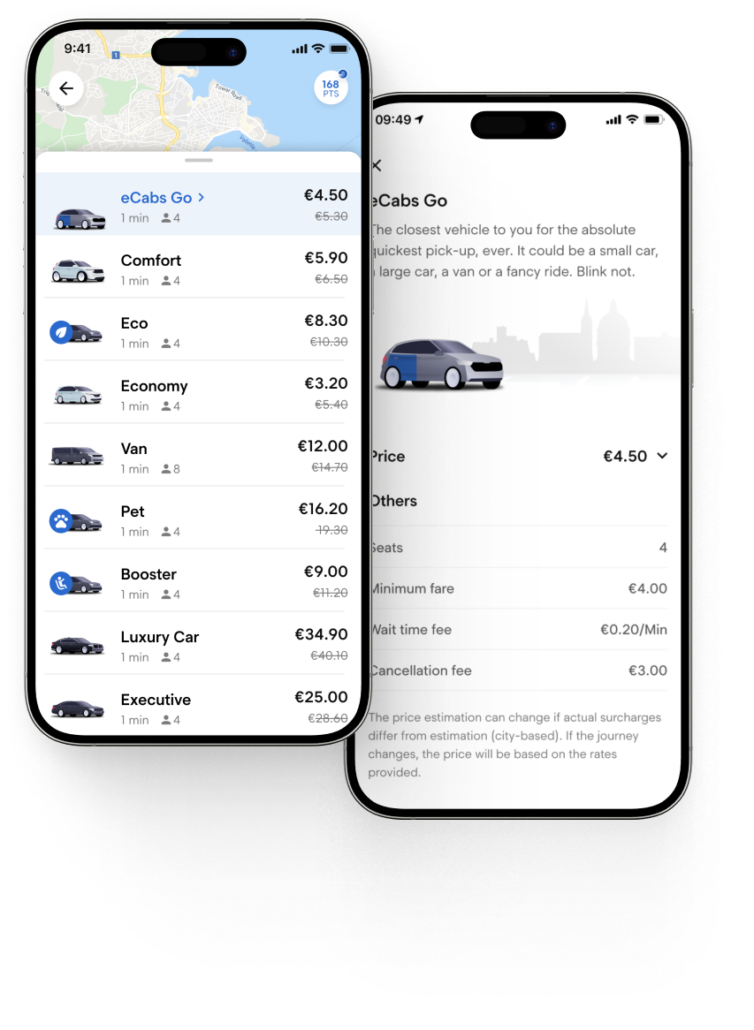
        • Reliable Features: Trustworthy fare estimates, real-time driver tracking, and transparent ride options are the hallmarks of an app that works. These are non-negotiable elements we prioritize.
        • Consistency Across Platforms: Whether you’re a new rider in Malta or a regular in Athens, consistency ensures users know what to expect every time they open the app.

        By focusing on these fundamentals, eCabs delivers a dependable experience, empowering users to focus on their journey—not the technology.


         The Power of Consistency: Building Trust One Screen at a Time

        In a small but competitive market like Malta, lack of trust is a dealbreaker. An inconsistent app experience—whether in design, pricing, or functionality—can erode user confidence. At eCabs, consistency underpins everything we do.

        • Transparent Pricing and Tracking: From fare estimates to live driver updates, our app ensures users know exactly what to expect. No surprises, no stress.
         
        • Cohesive Visuals and Navigation: Consistency across every screen of the app reinforces reliability and professionalism, making users feel in control.

        This approach is deeply rooted in the Law of Uniform Connectedness, which emphasizes that consistent design fosters clarity and confidence, guiding users seamlessly through the app.

        Speed and Simplicity: Essential for On-the-Go Users

        In the fast-paced ride-hailing environment, speed is everything. When users need a ride, they want it booked in seconds, not minutes. Hick’s Law—which states that reducing choices speeds up decision-making—shapes our approach to design.

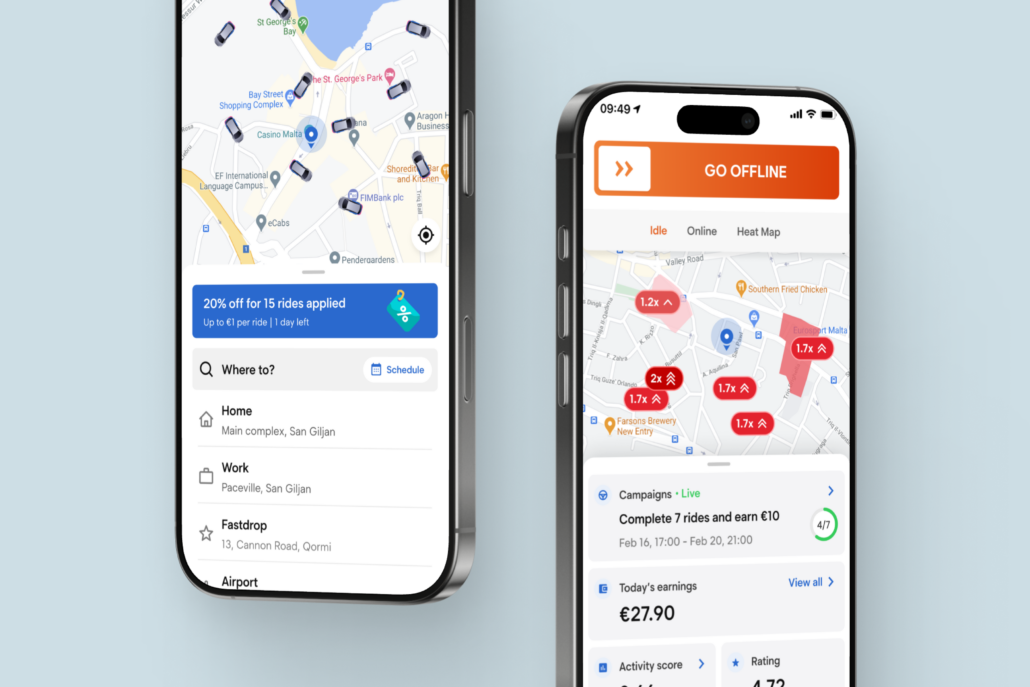
        • Pre-saved Locations and Preferences: For frequent riders, saved destinations like “Home” or “Work” simplify bookings, eliminating unnecessary steps.
        • One-tap Payments: With payment methods saved and ready, the booking process is swift and hassle-free.

        By reducing complexity, we make every interaction faster and more enjoyable—a critical edge in Malta’s competitive ride-hailing landscape.

        Learning from the Competition

        Malta’s ride-hailing market is shaped by the presence of global players like Bolt and Uber, both of which bring strengths that set high expectations for riders. Bolt’s competitive pricing and promotions attract cost-conscious users, while Uber’s global reputation for reliability and innovation appeals to those seeking consistent service.

        While these brands excel in their areas, eCabs stands apart by combining local expertise with the highest standards of service. We go beyond affordability and reliability, tailoring our approach to Malta’s unique challenges—navigating narrow streets, optimizing routes, and offering features designed for both locals and tourists.

        By balancing value, innovation, and a deep connection to the local market, eCabs delivers an experience that feels personal, seamless, and uniquely Maltese.

        Catering to Diverse Markets

        While eCabs dominates Malta’s ride-hailing market, eCabs Technologies also powers white-label solutions for operators in other countries, such as blue.ro in Romania and taxi.gr in Greece. These partnerships demonstrate our platform’s adaptability to different market needs, enabling operators to maintain their unique brand identity while delivering world-class services.

        • Tailored Solutions: We customize our platform to align with local demands, ensuring operators can serve their users effectively.
        • Scalable Technology: Our robust infrastructure supports growth, handling high-demand periods and expanding fleets with ease.
        • Focus on Quality: By sticking to the principles that work—reliability, transparency, and efficiency—we empower our partners to excel in their respective markets.

        Looking Ahead: The Future of Ride-Hailing in Malta

        The ride-hailing industry is evolving rapidly, and Malta is no exception. At eCabs, we’re constantly exploring new ways to improve our services and stay ahead of emerging trends.

        What’s next?

        • Eco-friendly Rides: With Malta’s growing focus on sustainability, we’re expanding options for electric vehicles and shared rides, aligning with the island’s green goals.
        • AI-driven Personalization: Predictive features that anticipate your ride preferences—such as offering a ride suggestion based on your past habits—will make the app smarter and more user-friendly.
        • Enhanced Routing: Smarter algorithms and real-time traffic updates will further reduce waiting and journey times, especially during peak hours.

        By staying ahead of these trends, we ensure that eCabs remains the go-to choice for ride-hailing in Malta.

        Why UX is at the Core of Our Success

        At eCabs, we don’t just design an app—we design experiences. Every decision, from simplifying booking flows to enhancing consistency and speed, is rooted in a commitment to putting the user first. In Malta’s competitive market, where every interaction counts, our focus on exceptional UX sets us apart.

        Whether you’re a local commuting to work or a visitor exploring the island, eCabs is more than a ride—it’s a service designed to meet your needs, anticipate your expectations, and deliver value every time.


        The best UX solution’s are not flashy—they are the ones that make life simpler, one ride at a time. – Kristen Jim


        By Kristen Jim, eCabs Technologies’ UX/UI Designer


        Take your taxi or ride-hailing service to the next level with eCabs Technologies’ white-label solutions. Click here to see how we can help.

        eCabs Technologies CEO tells UN body of ‘sandboxing’ opportunities in Malta

        Matthew Bezzina spoke at the recent Global Innovation Forum.


        Malta presents the perfect sandbox to test tech start ups, but scaling internationally is where the real challenge begins, eCabs Technologies CEO Matthew Bezzina told a United Nations event.

        Speaking at the Global Innovation Forum last month, Bezzina weighed in on the complexities of scaling a business initiated in a small market, but said that given its seasonality, small size, and dynamic market, Malta is a perfect destination to test new technology solutions.

        “For context, eCabs launched 15 years ago, the same year Uber started in the US and five years before Bolt. Sandboxing in Malta was perfect for us as we were able to test out ride-hailing technology in urban, suburban, and rural settings all at the same time and able to tweak our product in real time,” Bezzina explained.

        The same, he said, could be true for other emerging technology in different contexts.

        He emphasised that the regulatory landscape of a small, island nation like Malta required tailored solutions that did not always align with approaches used in more expansive markets.

        This, however, proved to be a major asset for the company.

        Bezzina said that being forced to have flexibility when designing the eCabs product over the years, positioned him and his team to understand the pain points of operators in diverse markets.

        In packing this unique operational understanding, together with their tech, and their insights into marketing and different regulatory contexts, eCabs is now seeking to empower shared mobility companies to embrace digitisation.

        Bezzina highlighted that while Malta’s size allowed eCabs to rapidly test and implement new technologies, expanding beyond national borders demanded an entirely different strategy.

        “The process involves not only adapting to diverse regulatory requirements but also understanding the cultural and operational nuances of new regions,” he noted.

        The forum, hosted by the International Telecommunication Union (ITU) in Malta, gathered global tech leaders to discuss the future of digital transformation and entrepreneurship.

        The ITU, headquartered in Geneva, Switzerland, is the UN’s oldest specialised agency and has been connecting the world since 1865.

        With a membership comprising 194 Member States and over 1,000 companies, universities, and international organisations, the ITU’s Global Innovation Forum is a hub for exchanging ideas that shape the global tech landscape.

        Bezzina was joined by Abi Gooch, the Global Corporate Responsibility Strategy Leader at Ernst & Young, Adma Rahman, Head of Entrepreneurship Innovation Centre, Ministry for Education, Brunei, Rosario Huaranaca Quispe, Generation Connect Youth Envoy, Bolivia, Prof Russel Smith, Director of the Centre for Entrepreneurship and Business Incubation, University of Malta, and Zhuoyong Shi, Generation Connect Youth Envoy, China.

        Asked what he felt underpinned the eCabs story, Bezzina said that successful scaling hinges on an agile mindset and a robust foundation built on trust.

        “Building trust in a market as compact as Malta gave us the core advantage we needed when approaching larger, more complex markets,” Bezzina remarked.

        He credited the lessons learned from navigating Malta’s regulations and customer expectations as instrumental in preparing eCabs for international expansion.

        Today eCabs powers successful ride-hailing operations in Malta, as well as Athens, Greece, and Bucharest, Romania, with several other European jurisdictions in the pipeline for 2025.

        With more than 450 employees and a quarter of a million rides completed monthly, the company has undergone considerable growth.

        For more information visit the eCabs Technologies website.

        In the Press:

        Times of Malta | Newsbook

        Behind the code: innovative minds, seamless rides

        Explore the story, challenges, and solutions ‘behind the code’ with eCabs Technologies’ Backend Team Lead, Burak Aykan Ürer.


        What are the main responsibilities of a backend developer in your team?

        Working in backend development at eCabs, I focus on designing, developing, and maintaining our server-side logic and databases. I write clean, efficient, and reusable code to ensure seamless platform operation.

        My day-to-day involves collaboration, code reviews, mentoring, and optimising for performance, scalability, and security. I also troubleshoot and stay updated with industry trends to implement cutting-edge solutions.

        How does your team’s work contribute to fulfilling eCabs’ mission and improving transportation services?

        My team’s work is pivotal in fulfilling eCabs’ mission. We focus on backend infrastructure, ensuring it’s robust and aligned with company goals.

        By delivering high-quality, scalable solutions, we provide a seamless user experience, revolutionising transportation services. Our emphasis on code quality and performance optimisation positions us for long-term success and growth.

        Can you share a specific project that you are proud of, and what challenges you faced during its implementation?

        One project that I’m particularly proud of is our multi-tenancy transition. Initially, our operations were exclusive to Malta, but this project marked a significant leap in our expansion strategy.

        It allowed us to extend our technology into both Greece and Romania, opening up numerous exciting possibilities for the future.

        However, this transition came with its fair share of challenges. Adapting our platform for multi-tenancy required a meticulous approach.

        We needed to ensure that each city partner could seamlessly and securely access their data and services while maintaining optimal performance and reliability across all regions.

        What strategies and actions did you take to tackle these challenges?

        To tackle these challenges, we conducted a comprehensive analysis of our existing infrastructure.

        This informed our strategy for implementing multi-tenancy, which involved an almost complete redesign of our backend architecture, optimisation of database schemas, and the establishment of robust access control mechanisms.

        Additionally, we put in place rigorous testing protocols to validate the scalability and security of the system.

        The successful execution of this transition not only expanded our operational reach but also positioned us for further growth and expansion into new markets.

        It stands as a testament to the dedication and expertise of our team in overcoming complex challenges and achieving strategic objectives.

        Can you describe the technologies and tools you use in your tech stack for backend development?

        As a backend developer, the arsenal of technologies at my disposal is diverse and tailored to meet the specific needs of our platform. Our tech stack is finely tuned to ensure the efficiency, scalability, and robustness of our services.

        For legacy services, Java 8 remains an essential component of our toolset, allowing us to maintain stability and support for existing systems. For newer services, we adopted Java 17, leveraging its cutting-edge features to build innovative solutions that align with industry best practices.

        How do you ensure scalability in your tech mobility platform, and what role do cloud-native architecture and microservices play in this?

        Frameworks play a pivotal role in our development process. Spring Boot is a cornerstone, enabling rapid application development and seamless integration with various components.

        Additionally, we’ve embraced Quarkus, harnessing its lightweight and reactive architecture to further enhance the performance of our applications.

        In terms of databases, we rely on Postgres for its reliability and robust feature set. For more specialised data requirements, we have integrated MongoDB, offering flexibility and scalability for specific use cases.

        As for message queuing and communication, we utilise RabbitMQ to facilitate asynchronous communication between different parts of our system. We also leverage pubsub mechanisms to ensure real-time updates and notifications.

        Containerisation and orchestration are fundamental to our deployment strategy. Kubernetes forms the backbone of our container orchestration, providing a scalable and resilient environment for our services.

        This, in conjunction with our cloud infrastructure, is hosted on Google Cloud Platform (GCP), ensuring a secure and performant environment for our applications.

        In essence, our tech stack is a carefully curated blend of proven technologies and innovative solutions. It allows us to deliver a high-performance platform while maintaining the flexibility to adapt to evolving industry standards and user demands.

        How do cloud-native architecture and microservices contribute to this scalability?

        Scalability is central to our tech mobility platform. We adopt cloud-native architecture and microservices, allowing us to independently scale components based on demand.

        Auto-scaling and horizontal scaling ensure seamless handling of increased user activity. Rigorous testing and load balancing fine-tune performance. Our team continuously explores emerging tech to enhance scalability.

        Our development process thrives on effective collaboration. Working closely with product managers, designers, frontend developers and mobile developers, I ensure a clear understanding of project goals. Continuous communication, including stand-up meetings and design reviews, keeps us aligned.

        With frontend and mobile developers, we establish seamless integration and troubleshoot together. Knowledge-sharing and cross-training further enhance our collective expertise, leading to high-quality solutions.

        Continuous learning is fundamental in software development. Staying updated with emerging technologies is imperative.

        In the dynamic field of software development, complacency is not an option. Keeping pace with emerging technologies is crucial.

        Recent breakthroughs such as serverless architectures and widespread Kubernetes adoption have reshaped how we develop and deploy. This adaptability ensures our solutions remain cutting-edge.

        Our development process thrives on effective collaboration. Working closely with product managers, designers, frontend developers and mobile developers, I ensure a clear understanding of project goals.

        eCabs Technologies Backend Team Lead Burak Aykan Ürer

        Embracing microservices empowers rapid response to changing demands. A steadfast focus on observability and stringent security safeguards system reliability and data integrity.

        The commitment to continuous learning not only enhances our capabilities but also leads to innovative and effective software solutions.

        In the fast-paced, competitive market of ride-hailing, sustaining innovation and agility is pivotal. We actively seek customer feedback and foster a culture of experimentation.

        Agile methodologies empower us to swiftly adapt to changing needs. Additionally, we keep a vigilant eye on industry trends and invest in ongoing learning.

        This comprehensive approach ensures we stay at the forefront of development, remaining both competitive and responsive to our customer base.

        What advice would you offer to aspiring backend developers entering the tech mobility industry

        I would advise aspiring backend developers looking to enter the tech mobility industry to focus on a few key areas.

        Firstly, mastering core backend technologies is crucial. This forms the foundation of your technical prowess.

        Additionally, familiarise yourself with cloud platforms like AWS or Google Cloud, as they’re integral for creating scalable and reliable infrastructure.

        Understanding microservices architecture is equally important, as it allows for flexibility and scalability in complex systems.

        APIs are a cornerstone in mobility services, so becoming proficient in designing and working with them is essential.

        Given the sensitive nature of user data, prioritising knowledge of data security, encryption, and privacy regulations is paramount.

        Lastly, remember that continuous learning is non-negotiable. The tech industry is ever evolving, so staying curious and open to adopting new tools and frameworks is imperative.

        This combination of technical proficiency, problem-solving abilities, and a passion for learning will undoubtedly pave the way for success in the tech mobility industry.


        By Burak Aykan Ürer, eCabs Technologies Backend Team Lead

        A passion for research and continuous development

        eCabs Technologies Product Owner Stephanie Farrugia gives an insider’s perspective on how she and her team navigate the ever-changing landscape of the mobility sector and how her pivotal role allows her to indulge on her love of continuous development and research.


        Can you provide an overview of your role as a Product Owner at eCabs Technologies?

        My role within eCabs Technologies is quite dynamic. I am the Product Owner of Data, which is a crucial business enabler, as it empowers key stakeholders to take timely and informed decisions from both a strategic and operational viewpoint.

        To achieve all this, the primary responsibilities include that of making sure that the underlying data infrastructure is operating smoothly. As well as performing ongoing prioritisation of incoming data requests by validating the respective business impact.

        In my role, I also need to provide support to all my fellow Product Owners in providing the necessary data analytics as a pre-requisite to designing new features.

        As a Product Owner, and together with the team when specific data reporting requirements pose a technical challenge, we make sure that we investigate and seek the right technical approach to deliver the expected level of visibility.

        During the first part of my exciting journey with eCabs I worked on the Customer App mainly in identifying and analysing new features that would facilitate the customer journey.

        Supported by our UI/UX team, we facilitated the pickup process, making it easier for customers to select pickup points within busy areas and on special events, amongst many other innovations.

        It is most satisfying to make use of the same features as a customer eventually, which I definitely did!

        How does eCabs prioritise which new features or products to work on, and what role do you play in shaping these decisions?

        As a Product team we are responsible for devising the roadmap of all our products.

        We base the order of priority for developing listed features on the scale of impact a feature would have on its stakeholders, supported by market research and data analytics, since we want to deliver the features and products that matter most.

        We also consider the cost and effort involved in developing any given new feature compared to its business value.

        eCabs and Google, with the support of TIM Italia and Noovle Malta Ltd, recently partnered up to exploit the use of machine learning and ways how through this technical concept eCabs would be able to provide a unique personal experience to our esteemed customers.

        This would be achievable through the application of algorithms on both historical and real time data that would predict customer preferences based on identified behavioural patterns and external dynamics that affect these patterns.

        We also take pride in being among the first global ride-hailing platforms to leverage the distinctive capabilities of the Google Maps Mobility Platform. By harnessing real-time data, we ensure precise dispatch, accurate estimated time of arrivals (ETAs), hyper-intelligent route optimisation, and dynamic pricing. This approach not only facilitates expedited rides but also enhances cost efficiency for the benefit of our valued passengers and drivers alike.

        Could you tell us about your interactions with other eCabs Technologies teams?

        This is one of the most rewarding aspects of our role in that we first devise an idea and translate it into a Product Requirement Document inclusive of a detailed analysis as how we plan to fulfill the given requirement.

        Once reviewed by the respective Product Owner within the team, we initiate a chain of communication with other teams starting from the Solution Architect going on to the developers when we start discussing our product from a technical viewpoint, possibly discussing specific recommended adaptations.

        Eventually once the product is developed, our Quality Assurance (QA) team would be involved to ensure the product has been delivered as based on the ‘Behaviour-Driven-Development’ (BDD) scenarios that we would have documented previously which describes the expected behaviour based on a given action.

        Once QA completes their testing, the product is ready to be released and all the work comes into fruition!

        What challenges have you encountered while working on product development at eCabs, and how did you and your team overcome them?

        Prioritisation is always a tricky game as the mobility sector is a fast-paced industry. Being ahead of the curve is the only way to remain ahead of competition and setting the trends rather than following them.

        As a Product team we remain sensitive to market developments and by following the prioritisation criteria previously explained, we do adapt our product roadmap when this is evidently required.

        eCabs Technologies operates in various markets. Can you share some insights into how you adapt your product strategy to suit different geographic regions or customer preferences?

        Investing in localisation tools, starting from language translation, is key while researching on specific regulatory compliance requirements relevant to targeted regions is crucial.

        We… take pride in being among the first global ride-hailing platforms to leverage the distinctive capabilities of the Google Maps Mobility Platform.

        eCabs Technologies Product Owner Stephanie Farrugia

        Our vision underlying our product strategy is to ensure ease of adaptability in offering a dynamic platform aimed to empower our prospective tenants to let them decide on the deployment or not of certain features including the support for different pricing strategies suiting different market landscapes.

        Our operational strategy is focused on speeding up and fine tuning the process to bring changes and country specific product requirements to market quickly.

        Can you highlight any memorable success stories or milestones from your time as a Product Owner?

        As a Product Owner and ably delivered by the data team and well mentored by the key stakeholders, we devised a reporting dashboard that leverages our 14 years of operational experience to support both our current and prospective tenants.

        This way, once onboarded, they immediately gain visibility on their operational performance in almost real time.

        Ongoing competition and market analysis while subscribing to relevant technical resources is key to keeping up with the momentum of this fast-moving industry.

        Knowledge sharing across teams is also extremely helpful, which is a concept well encouraged and facilitated by the company.

        What excites you about eCabs Technologies’ future in the mobility industry?

        The seamless integration of cutting-edge technologies from industry leaders such as Google Cloud empowers our platform to not only navigate and capitalise on prevailing market opportunities but also ensures our readiness for the challenges and innovations that tomorrow may bring, such as autonomous vehicles, for instance.

        The fact that there are increasing pressures for sustainability and environmental policies to be in place means that I perceive the mobility industry to play a key role in supporting this crucial mind shift supported by serious commitment from all.

        Cultivating a driver-centric culture at eCabs

        Building the future together

        6:00 AM—The sun is just beginning to rise as Grace, an eCabs driver with three years of experience, wakes up to start her day. She grabs her phone and opens the eCabs Driver App, which displays a personalised dashboard. She notices that there’s a surge in demand near Msida due to a morning conference—a detail highlighted thanks to our real-time data analytics.

        6:30 AM—After a quick breakfast, Grace heads to her car. Before setting off, she checks the new driver campaigns feature in the app. This week, there’s a challenge to complete eight rides for a bonus. Motivated, she accepts the challenge.

        7:00 AM—Grace picks up her first passenger, a business professional heading to the conference. The app’s navigation, powered by our partnership with Google Maps Mobility Platform, suggests the fastest route, avoiding unexpected traffic from an accident reported moments ago. The passenger is impressed with the smooth ride and leaves a five-star rating.

        8:00 AM—Between rides, Grace receives a notification about surge pricing activated in her area—an update we implemented after drivers requested a way to maximise earnings during peak times.

        9:30 AM—She stops by Ottimo Cafè for a quick coffee break. There, she chats with other drivers about the new gamification features. Some are excited about the friendly competition.. The shop buzzes with camaraderie, reinforcing the sense of community.

        10:00 AM—Back on the road, Grace is also participating in a beta test for an upcoming app navigation feature using the new build. As a driver who frequently provides feedback, she’s invited to try out new tools before they’re released. She appreciates that her suggestions are valued and often see the light of day in app updates.

        12:00 PM—After several more rides, Grace checks her progress on the driver campaign. She’s halfway to her goal. The gamification elements make her work feel more engaging, almost turning her day into a rewarding game.

        2:00 PM—She picks up a passenger who mentions how much they enjoy using eCabs, citing positive experiences with friendly drivers like Grace. This feedback boosts her spirits, reminding her why she loves her job.

        4:00 PM—As Grace wraps up her day, she reviews her earnings, which are higher thanks to the surge pricing periods and the driver campaign which she has now completed. Feeling accomplished, she heads home, looking forward to the next day’s challenges.


        At eCabs, drivers like Grace are at the heart of everything we do. By immersing ourselves in their daily experiences, we understand the importance of tools and features that make their work more efficient, profitable, and enjoyable.

        Like our CEO Matthew Bezzina says, ‘we respect the past, but we build for the future’. Our journey from a traditional dial-a-cab service to a leading digital ride-hailing platform has been guided by putting our drivers first.

        Driving Innovation from Behind the Wheel

        To truly understand our drivers, we need to experience their world. While some of us come from tech backgrounds, key members of our team are former drivers.

        Their firsthand insights shape our product development, ensuring we address real challenges. They share stories about navigating busy streets, engaging with passengers, and the nuances of day-to-day driving that only someone behind the wheel would know.

        By integrating their experiences, we’re able to build solutions that genuinely make a difference.

        Collaborating on Features That Matter

        We don’t make assumptions about what our drivers need—we ask them. Through beta test sessions, ride-alongs, and regular conversations at our garages, we maintain open communication.

        This collaborative approach led to the implementation of surge pricing, a highly requested feature that helps drivers like Grace maximise earnings during peak demand.

        One driver shared, “The introduction of surge pricing has really boosted my income during busy times. It’s great to see eCabs listening to us.”

        Building the Future Together

        The mobility industry is changing fast, and our drivers are at the forefront of this transformation. We understand that embracing innovation is a team effort.

        By involving drivers—including former drivers now on our team—in the development process, we’re able to anticipate needs and deliver solutions that keep us all ahead of the curve.

        Moreover, eCabs Technologies is actively engaging in collaborative consulting and testing initiatives with our international city partners. This ensures that our solutions are seamlessly aligned with the unique needs and expectations of each urban environment.

        Your Voice Matters

        Every driver has unique insights that contribute to our collective success. We’re committed to fostering an environment where voices are heard, ideas are valued, and contributions are recognised. After all, building the future of mobility is a journey we’re on together.

        Are you an eCabs driver with ideas to share? Or maybe you’re interested in joining a company that values your input and invests in your growth? Reach out to us today and be part of shaping the future of ride-hailing.

        Together, we’re not just driving cars—we’re driving change.

        Check out our full-time and part-time vacancies.


        By eCabs Technologies’ Product Owner, Driver Experience: Asemota ‘A.I.’ Ize-Iyamu

        Traversing the Agile seas: a Scrum Master’s journey

        The idea of helping people to help themselves is probably the key factor which drew me towards becoming a Scrum Master.

        My journey into Agile, not just Scrum, has been a long one. I was one of the first three Scrum people certified in Malta (one other Scrum Master and a Scrum trainer).

        Can you tell us a bit about your professional journey in this field?

        Agile and Scrum were practically non-existent on the island back in 2007. Along with the other qualified Scrum Master, we had started an NGO called Agile Malta. Through this NGO, we used to hold Agile focused conferences and used to help companies to transition to the Agile mentality.

        Over time, I learnt different Agile methodologies which have progressed towards scaled Scrum.

        Can you provide an overview of your role as a Scrum Master at eCabs Technologies? What are your primary responsibilities and objectives?

        When I joined eCabs, one of the very first things I noticed – and liked – was that the company was not developing a ride-hailing platform separate from everything else. But as a consolidated operator platform, integrating app, phone, web and API integrated bookings, amongst others.

        My role has evolved from aiding eCabs Technologies’ tech team to understanding Scrum, to helping them to understand their autonomy and self-responsibility.

        My primary objective is to ensure that we give back the flow of work from our customer and product team’s minds, along with our company experience, to our customers with a high level of quality.

        eCabs Technologies is known for its tech-driven culture. How does the Scrum framework contribute to the development and improvement of these solutions?

        Scrum fosters the creation and maintenance of a mentality of small increments totaling up to one great improvement. Based on how the local and foreign customers and business are progressing over time.

        Changing people’s behaviour is never easy. But the Agile/Scrum perspective comes to the rescue in the form of small changes over time. In terms of what we communicate, as well as when and how. All the while focusing on how people are feeling during the communication exchange.

        My main objective is getting the tech teams to functional in a holistic and professional manner. In the long run, my end game is to foster collaboration and self-management across the entire company.

        eCabs Technologies Scrum Master Aldo Cauchi Savona

        At eCabs Technologies, my main objective is getting the tech teams to functional in a holistic and professional manner. In the long run, my end game is to foster collaboration and self-management across the entire company.

        Communication is enhanced with the use of informative automated boards. As well as the use of Slack and Scrum’s correlated rhythmical set of meetings, one of which occurs daily.

        Getting all team players rowing in the same direction at the same time, where all the company is working as a team, will allow us to beat groups of any size.

        What advice would you give to aspiring Scrum Masters who are looking to excel in their careers within the tech industry?

        It is good to always keep in mind that Scrum is not unique or special only to tech companies. Social sciences use what they call a ‘grounded thinking’ methodology, which involves the cyclical application of inductive reasoning.

        In anything in life – not only in the tech industry – start small and cyclically build yourself. All the time, adapting your current short-term plan towards achieving a long-term goal, which is also an ever evolving and constantly changing process.

        For instance, improvements through small increments is also an aspect of physical therapy (which I travel abroad yearly for after a nasty incident a few years ago which left me in need of the aforementioned therapy.)

        My personal experience has taught me that, sometimes, even those things that are deemed impossible or unlikely, are achievable. With the right mindset, the appropriate direction, and a dose of hard work from your end. And I try to apply that reasoning to everything I do.

        Interested in joining the eCabs Technologies team?

        Check out our current job openings here.


        By eCabs Technologies’ Scrum Master Aldo Cauchi Savona

        The innovator’s dilemma: Legacy taxi operators vs Uber

        The last of the taxi roof lights are flickering out, and their once-buzzing dispatchers’ radios are falling silent. Across Europe and beyond, long-standing legacy taxi operations face a formidable challenger: ride-hailing applications like Bolt and Uber are sweeping through every market, in every jurisdiction, gobbling up riders and drivers alike.

        Contrary to what you might read elsewhere, legacy taxi businesses do not face an uncertain future. They face a clear and inevitable reality: ride-hailing is here to stay. The critical question as the rides industry continues to grow year-on-year is not if traditional taxi businesses will survive but who will take the largest slice of the pie: disruptors or traditional operators?

        The dangers of complacency

        Fifteen years ago, eCabs was born as a traditional dial-a-cab business. Like most legacy taxi businesses, we manually registered bookings and dispatched rides from our bookings office. I remember those days—passengers queuing outside our dispatch centre after a night out, drivers waiting idly for their turn to be called on the tannoy.

        However, we founded eCabs with the intent to digitize our rides service. We built our own digital platform, on bare metal infrastructure, with all the complications that come with it. We’ve experienced the tricky transition from one system to another—patches upon patches, and late-night scrambling to get back online. All the while, we were competing against the largest ride-hailing platform in the region, Bolt.

        Over the years, I’ve learned that disruption can come in pitter-patter, showers, or torrential downpours. In Malta, it was a deluge. After Bolt, came Uber. Today, eCabs is the only locally grown ride-hailing operation in its home market, with other businesses in different jurisdictions running on our platform. This success stems from our continuous investment in our digital offering, from partnering with global leaders like the Google Maps Mobility Platform to headhunting talent from leading ride-hailing tech players.

        Facing the real threat

        What we’ve learned is that the greatest threat traditional taxi businesses face today isn’t innovation and disruption; it’s the temptation to ignore transformative change. The danger is in burying heads in the sand, hoping ride-hailing tech will simply go away. Take it from me—it won’t. These giants are coming for the traditional taxi businesses, and the answer isn’t in ignoring the change but embracing it.

        Legacy operators must become disruptors themselves if they want to survive. Harvard Business School professor Clayton Christensen introduced the concept of the Innovator’s Dilemma in 1997, explaining how established companies often focus on sustaining innovations—incremental improvements to existing products—at the expense of recognizing disruptive innovations on the horizon. These major changes may initially serve niche markets, but they have the power to redefine entire industries.

        For legacy taxi businesses, the disruption came in the form of ride-hailing apps. Ignoring these innovations is a recipe for obsolescence. As Uber’s own CEO Dara Khosrowshahi said nearly seven years ago: “If you don’t disrupt yourself, someone else will.”

        How to fight back

        Digital transformation isn’t a button you press; it’s a process. What eCabs has developed isn’t just a white-label patch for legacy businesses trying to add a digital component to their service. We’ve packed 15 years of hands-on industry expertise into a platform built from real-world experience—competing against global ride-hailing giants, managing fleets, developing data-driven rider marketing campaigns, and educating policymakers.

        This isn’t a first aid kit for traditional businesses; it’s a journey for operators who want to become regional leaders in mobility. Because make no mistake, global ride-hailing platforms aren’t coming for a piece of the pie—they want the entire thing.


        By Matthew Bezzina, eCabs Technologies CEO


        Matthew Bezzina will be a key speaker at the upcoming Start-Up Festival in Malta. The festival brings together entrepreneurs, investors, and enthusiasts to explore cutting-edge technologies, disruptive business models, and groundbreaking solutions. A highlight is the “Dream Big Malta” panel, celebrating the achievements of individuals from Malta excelling in international business, professions, or sports.

        The original article may be found here.