The Driver App powers your fleet: from accepting rides to tracking earnings and hitting bonuses. Built to boost performance, build loyalty, and cut churn, it’s the essential tool for a smooth, high-performing operation.


I was watching a documentary on National Geographic…
A massive buffalo stands its ground: strong, dominant. Then out of nowhere, a komodo dragon approaches, bites once, and backs off.
That’s all it needs.
The wound festers. The buffalo’s blood thins. Within days it weakens, stumbles, and collapses. Then the dragon returns – with others – to devour it. Piece by piece.
The narrator delivers the final line with chilling certainty:
“Everything is eaten. Don’t expect any leftovers from this gruesome feast”
Now, let’s talk about ride-hailing.
They’ve acquired your software provider.
They penetrated your market
They’ve onboarded your drivers.
They’ve studied your pricing.
They’ve outspent you in rider demand.
And now?
They’re waiting.
Waiting for your outdated system, cost-heavy growth model, and manual operations to do the rest of the job for them.
They’re patient. Funded. Efficient.
And they know they don’t need to fight hard. They just need to wait for your dispatch system to collapse under its own weight.
We’ve seen local legacy PHV and taxi operators delay Bolt and block Uber. Protect licenses. All good moves – if they buy you time to modernise.
But too many take that time and use it to… do nothing.
Meanwhile, the market shifts. Riders churn. Drivers drift. Internal ops drag. And the predators move in.
We’ve talked to operators who grew 5-10% last year. They were proud of it, until they realised Uber was growing 30% in the same market, quieCabs Technologiesy gaining driver loyalty and market share.
It’s not about whether you’re growing.
It’s about whether you’re being outgrown.
Bolt’s 2024 Ride-Hailing Economy Report couldn’t be clearer: earnings per hour is the #1 driver motivator.
Drivers don’t stick with platforms out of loyalty. They log in where they’re most likely to earn more – now. Over 80% of drivers in France and Portugal use multiple apps. Most drive less than 20 hours a week.
Lyft’s 2024 Economic Impact Report tells the same story across the Atlantic:
You’re not just competing for drivers anymore.
You’re competing for fractions of their time.
We’ve seen operators cut commissions from 20% to 10% just to retain supply. It rarely works.
Why? Because 90% of 0.5 rides/hour is still worse than 80% of 1.4 rides/hour.
If you can’t drive demand, no commission cut will solve it.
If those same operators had the right segmentation tools, incentive mechanics, and rider-side promotions, they could have kept commission stable – and used the extra margin to boost volume.
Many operators are still paying software providers per driver or vehicle.
That pricing model may have worked a decade ago, when drivers were full-time, loyal, and platform-exclusive. But that’s not today’s reality.
Now, if you’re lucky, you get 30% of a driver’s available time.
Which means, just to guarantee coverage, you’re often buying 2 or 3 licenses to replace what used to be covered by one.
And here’s the trap:
Every time you try to improve your service – by scaling supply to reduce ETAs, increase availability, or optimise zone coverage – your software cost balloons.
Uber doesn’t pay more when it adds drivers. Their unit costs improve.
You pay more, and your unit economics fall apart.
You’re being penalised for growing the very thing that keeps you in the game.
That’s not just outdated, it’s unsustainable.
You can’t compete for driver hours, rider experience, or operational efficiency when your platform charges you more for trying to improve.
The market has moved on.
If your software pricing model hasn’t, you’re stuck in a game you can’t win.
We see this every week:
It’s not a dramatic failure. It’s a slow, quiet erosion.
One workaround. One late update. One more thing you can’t control.
And the Komodo keeps watching.
They’re not just running fleets. They’re running a ride-hailing marketplace.
That mindset shift is the only thing that gives them a shot.
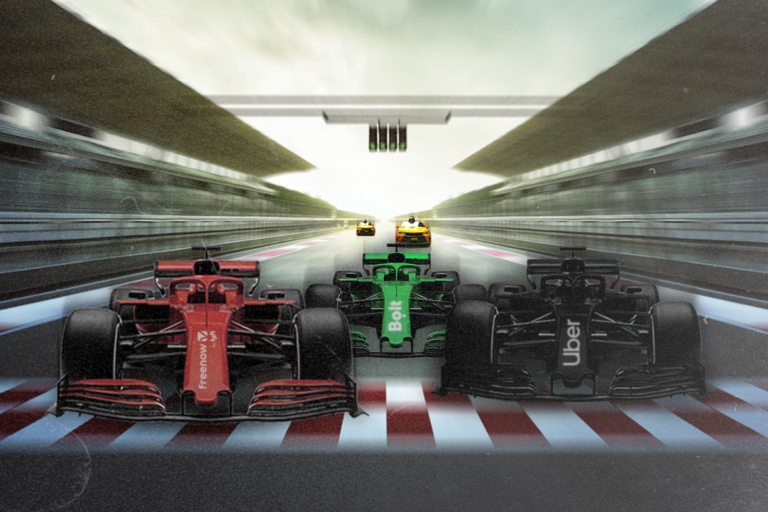
Uber and Bolt are circling a €200 billion feast.
And they’ve already bitten into most local operators.
They’ve done the hard part. Now, they wait.
Wait for the outdated pricing models to break.
Wait for legacy software vendors to stall your growth.
Wait for spreadsheet chaos to turn into operational debt.
Because they’re funded, focused, and agile.
And like that Komodo dragon on Nat Geo – they know how this ends.
The buffalo doesn’t die in the moment.
It dies slowly. Bleeding. Stumbling.
While the predators wait for the right time to clean the bones.
“Everything is eaten. Don’t expect any leftovers from this gruesome feast”
By Marvin Briffa, eCabs Technologies’ Head of Product & Operations

 Lyft Just Bought Freenow – and a Stake in Europe’s Taxi Future.