Product Updates
White Paper: The Final Fifty Meters
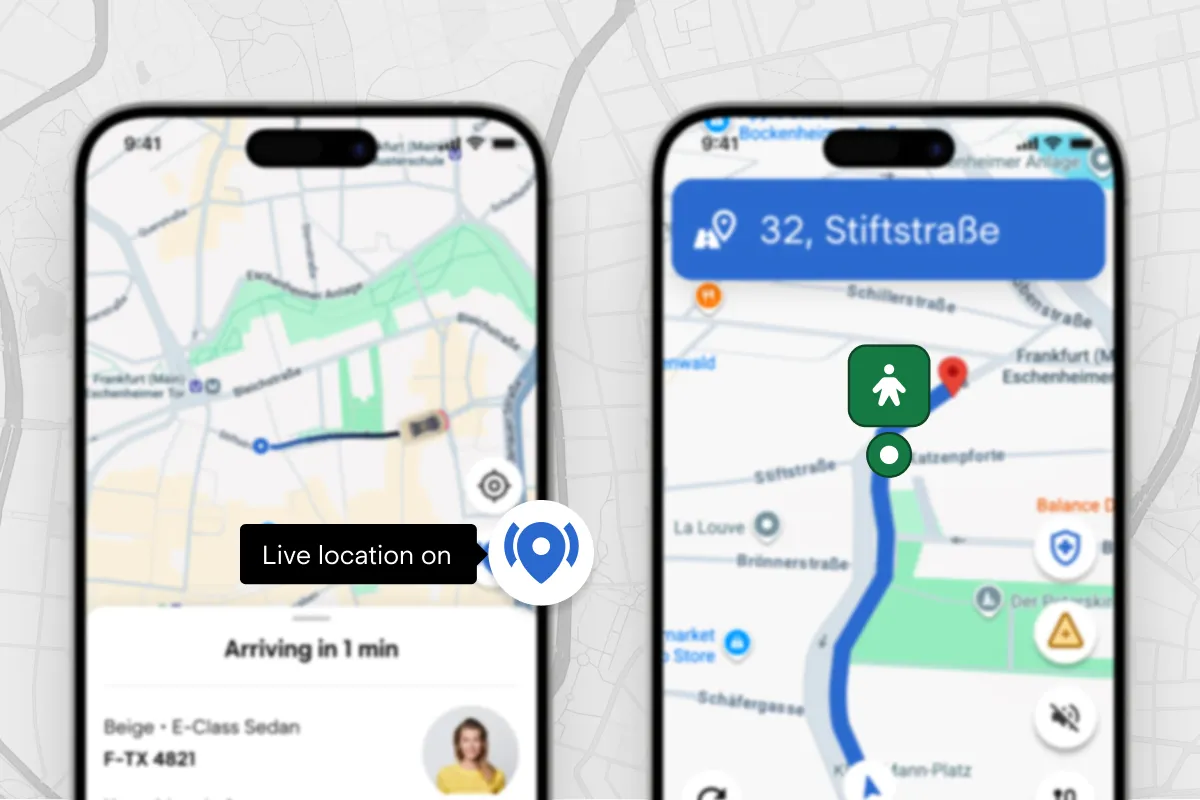
Quantifying the Economic Impact of Information Asymmetry in Urban Pickups
In the modern mobility landscape, the “Digital Match” (connecting a car to a booking) is a solved problem. However, the “Physical Pickup” remains the primary point of operational failure. This paper defines the “Dead Minute”—the period of uncompensated friction caused by GPS drift and rider movement. By transitioning from a Static Pin Model to a Dynamic Visibility Model, fleet operators can recapture up to 90 seconds of billable time per trip, directly improving fleet utilization and customer retention.
THE PROBLEM: THE COST OF THE “DEAD MINUTE”
Traditional dispatch systems rely on a Static Point Model. When a rider books a trip, a single GPS coordinate is sent to the driver. However, human behavior is dynamic. Riders move toward shade, away from rain, or around corners to find a better vantage point.
The result is Information Asymmetry: The rider knows exactly where they are, but the driver is looking at a “best guess” on a screen.
We identify this friction as the “Dead Minute.” It is the interval where:
- The vehicle is idling or circling the block.
- The driver is distracted by “Where are you?” phone calls.
- The trip meter is not yet active, meaning the vehicle is generating cost without revenue.
The Opportunity Cost: For a fleet of 500 vehicles, losing just 90 seconds of search time per trip across 15 trips a day results in 125 hours of lost billable capacity every single day.
THE 90-SECOND ADVANTAGE: EVIDENCE-BASED BENCHMARKING
The 90-second efficiency gain is the sum of three distinct operational recoveries:
- Navigation Recovery (45s): Eliminating the “Correction Loop.” In dense city centers, missing a rider by 10 meters can force a driver into a 2-minute “around-the-block” maneuver due to one-way streets. Live visibility allows the driver to adjust their approach lane before arrival.
- Communication Recovery (30s): Eliminating verbal descriptions. Visual certainty on a map replaces the need for time-consuming calls or messages.
Haptic Synchronization (15s): The “Last-Meter” search. When the driver and rider see each other’s movement in real-time, the “door-open” event happens faster, especially in crowded environments like train stations or malls.
THE SOLUTION: REAL-TIME COORDINATE STREAMING (RTCS)
eCabs Technologies resolves this friction through a high-frequency Rider-on-Map service. This moves the industry beyond the static pin into a state of continuous synchronization.
Key Technical Pillars:
- Intelligent Proximity Suppression: To prevent driver confusion, the system performs a real-time check at dispatch. If the booker’s device is detected far from the pickup pin (e.g. booking for a friend), the live stream is automatically hidden. The driver only sees data that is operationally relevant.
- Full-Lifecycle Visibility: The stream activates at the moment of dispatch and remains active through the “Arrived” state. It only terminates once the rider is marked as “Picked Up.” This ensures the driver has eyes on the rider during the most confusing part of the encounter.
- City-Level Configurability: Operators can fine-tune update intervals to balance the need for high-precision tracking against device battery life, ensuring the software fits the specific density of their city.
Privacy-First Design: Sharing is entirely ephemeral. No historical coordinates are stored post-trip, and riders have a manual toggle to opt-out at any time, ensuring full compliance with global privacy standards.
BUSINESS IMPACT: THE HALO EFFECT
Beyond the raw math of time-saving, the transition to Live Location Sharing creates a “Halo Effect” across the operation:
- Reduced Cancellations: High “uncertainty” leads to high cancellations. When a rider sees their own dot on the driver’s map, their “patience threshold” increases because they feel “seen.”
- Driver Satisfaction: The “Where are you?” call is the #1 source of driver stress. Reducing this friction improves driver retention and focus.
Safety: Drivers spend less time looking at their phones for landmarks and more time focused on the driving environment during the approach.
FROM SEARCH TO DISCOVERY
The future of professional mobility lies in the elimination of “empty time.” Legacy software that relies on static pins leaves taxi and private hire operators vulnerable to more agile, tech-heavy competitors.
By implementing Rider Live Location Sharing, operators do more than just improve a feature; they recapture lost revenue, stabilize their workforce, and provide a premium experience that meets the expectations of the modern traveler.