Tag Archive for: Matthew Bezzina

Insights from ERTA 2025: A Sector at a Crossroads

As platforms consolidate power, Europe’s taxi industry must decide: compete together, or fall apart alone.


Earlier this month, our CEO Matthew Bezzina was invited to speak at the European Taxi Radio Association (ERTA) annual conference, a closed-door forum for taxi operators across Europe. Representing eCabs Malta, powered by eCabs Technologies, Matthew joined industry peers for three days of working sessions, including structured country reports, general discussions, and roundtables on the future of the sector.

As always, the agenda covered a wide range of operational and strategic topics, from the integration of taxis into broader public mobility systems, to the growing role of AI in fleet management, and the accelerating shift toward electric vehicles. But running beneath all of it was a more urgent undercurrent: fragmentation.

It became clear that the sector’s biggest weakness today is not a lack of demand, nor even a lack of technology. It’s the absence of unified direction. And platform players are capitalising on that. Uber, Bolt, and now Lyft are embedding themselves more deeply into the market, not just by competing with taxi operators, but by absorbing them. From hybrid app-based taxi offerings to outright acquisitions and targeted lobbying, their strategy is clear: divide, then dominate.

The shift is striking. Where once these platforms relied on aggressive subsidies and incentive schemes to buy market share, they’re now advancing through consolidation. In a fragmented industry, acquisition is faster, cleaner, and far more scalable. Just this week, Uber acquired Denmark’s largest taxi firm, DanTaxi, a move that positions Uber not as an outsider, but as infrastructure. In March, Bolt’s acquisition of Viggo marked another step in the same direction.

The generational and structural rifts were palpable: between taxis and PHVs, between traditionalists and digital-first operators. Some attendees see the platforms as a threat to resist. Others view them as partners in a new reality. That divergence, and the lack of collective response it enables, is exactly what platform players rely on.

These conversations sparked important questions we’ll be exploring more deeply in the weeks to come. Our upcoming blog posts will take deeper looks at how fragmentation is being fueled (by design) and what legacy operators must do to push back. Because while platforms operate with clarity and cohesion, Europe’s taxi sector is still arriving with scattered responses. Events like ERTA 2025 are vital, not just to exchange updates, but to hold a mirror up to the industry. Legacy operators must ask hard questions, build common ground, and act with strategic clarity.

We were proud to contribute to this year’s conference and will continue bringing the on-the-ground perspective of eCabs Malta, one of the most active players in regulated urban mobility, to the wider industry. As fragmentation deepens and the market shifts, our experience, observations, and technology-led approach remain focused on helping operators across Europe adapt, align, and advance.

Matthew Bezzina at Meet-the-Cab 2025: Driving Taxi Industry Innovation

A look at Matthew Bezzina’s insights on adapting to change, leveraging technology, and driving the future of the taxi industry at Meet-the-Cab 2025 in Vienna.


At the Meet-the-Cab 2025 conference in Vienna, Matthew Bezzina, CEO of eCabs Technologies, delivered a compelling message to legacy taxi operators: the future belongs to those who embrace change and technology. Highlighting the stark reality facing the traditional taxi industry, Bezzina emphasised that competing with global ride-hailing giants requires more than just playing defense—it demands rapid evolution, smarter strategies, and a commitment to innovation.

Bezzina shared the story of eCabs Technologies’ 15-year journey, transforming through technology, agility, and a hyper-localised, customer-centric approach. He illustrated the importance of adaptation by referencing the frog in the pan, which fails to react to gradual change, and the turtle, which has survived since the time of the dinosaurs through continuous adaptation. This metaphor underscored his key message: evolution is not optional for survival in today’s fast-paced industry.

Meet-the-Cab 2025
Photograph by Angelo Kreuzberger

Representing both the technology and the operations behind Malta’s Private Hire sector at a traditionally taxi-focused event, Bezzina’s presence was a testament to the importance of open dialogue and collaboration across industry lines. Invited by Christian Holzhauser and Julia Schellnast from Taxi 40100, his participation highlighted a willingness to foster innovation and share strategies that drive the entire industry forward.

Bezzina’s presentation highlighted how eCabs Technologies leverages cutting-edge technology for operational efficiency and customer satisfaction, while emphasising the need for industry-wide innovation. He detailed investments in digital platforms, AI-driven pricing, automated dispatch, and eco-friendly fleet solutions, urging legacy operators to rethink strategies and adopt modern tools. The Meet-the-Cab 2025 conference provided a vital platform for these discussions, leaving attendees with a clear message: to survive and thrive, the taxi industry must evolve swiftly, embrace technology, and remain agile in an ever-changing market landscape.


By Matthew Bezzina, eCabs Technologies’ CEO

Drink-driving crackdown exposes Italy’s need for transport innovation

Italy needs to embrace the tech revolution to improve its transport options


A recent drink-driving crackdown in Italy has exposed how the country’s outdated taxi system needs to embrace new tech.   

A few weeks ago, the Italian government rolled out massive fines aimed at tackling drink-driving.  

While the harsh penalties—up to €6,000 per driver—proved effective in curbing drink-driving over the festive season, it also shined a spotlight on the lack of viable alternative transport options in cities across the country.

A broken taxi system

At the heart of the problem is an overly protected taxi sector.

Italy’s taxi industry remains one of Europe’s most restricted markets. Its licensing system caps the number of taxis, creating an artificial scarcity that drives up costs and limits availability.

As a result, finding a taxi in major cities has become a nightmare; getting around after midnight—especially during peaks in demand—is almost impossible.

Reports in leading Italian media in recent weeks speak of residents stranded at night, forced to walk home, or resort to even riskier alternatives.

From Florence to Rome, restaurants, bars, and clubs complain about how the new harsh anti drink-driving measures have left them with empty tables or slimmer margins as diners become increasingly cautious.

Tourists unfamiliar with local systems fare even worse, navigating a system that’s outdated and far removed from their expectations and needs.

For a nation hosting an average of 60 million tourists annually, this is more than a mere inconvenience—it’s an economic liability.

Put plainly, the fact that Italy’s transport infrastructure struggles to handle demand surges tarnishes its global reputation as a premier destination.

The need for disruption

The Italian taxi and Noleggio con Conducentesector (NCC) sectors urgently require innovation.

A new wave of entrepreneurial energy, paired with technology, could transform what has long been a stagnant market.

Platforms like eCabs Technologies demonstrate the potential of digital solutions—from dynamic pricing engines tailored to demand, to seamless integration with legacy systems.

Technology can indeed modernise the sector, creating a responsive, efficient, and customer-focused ecosystem. It’s time to move beyond regulation as the primary tool and embrace digital transformation to unlock Italy’s night-time economy.

As Italy grapples with these challenges, the path forward is clear: invest in technology, support innovative platforms, and enable entrepreneurial ventures.

By modernising its taxi and NCC offerings, Italy can not only meet its mobility and safety needs but also reinvigorate its economy, ensuring that both residents and tourists thrive.

Today, eCabs Technologies powers successful ride-hailing operations in Malta, as well as Athens, Greece, and Bucharest, Romania, with several other European jurisdictions going live in 2025. 

With more than 450 employees and a quarter of a million rides completed monthly, the company has undergone considerable growth. 

Find more information on how eCabs Technologies is leading the digital revolution for the shared mobility industry across Europe here.


By Matthew Bezzina, eCabs Technologies’ CEO

Guida in stato di ebbrezza: l’Italia ha bisogno di innovazione nei trasporti

L’Italia deve abbracciare la rivoluzione tecnologica per migliorare le sue opzioni di trasporto. 


Una recente stretta sulla guida in stato di ebbrezza in Italia ha messo in luce come il sistema di taxi obsoleto del paese debba evolversi e adottare nuove tecnologie. 

Alcune settimane fa, il governo italiano ha introdotto multe salatissime per combattere la guida in stato di ebbrezza. 

Sebbene le severe sanzioni—fino a €6.000 per conducente—siano state efficaci nel ridurre i casi di guida in stato di ebbrezza durante le festività, hanno anche evidenziato la mancanza di opzioni di trasporto alternative valide nelle città di tutto il paese.

Un sistema di taxi inefficiente

Al centro del problema c’è un settore dei taxi eccessivamente protetto. 

L’industria dei taxi in Italia rimane uno dei mercati più regolamentati d’Europa. Il sistema di licenze limita il numero di taxi, creando una scarsità artificiale che aumenta i costi e riduce la disponibilità. 

Di conseguenza, trovare un taxi nelle principali città è diventato un incubo; spostarsi dopo la mezzanotte—soprattutto durante i picchi di domanda—è quasi impossibile. 

Recenti articoli nei principali media italiani riportano storie di residenti bloccati di notte, costretti a tornare a casa a piedi o a ricorrere ad alternative ancora più rischiose. 

Da Firenze a Roma, ristoranti, bar e locali notturni si lamentano che le nuove e rigide misure contro la guida in stato di ebbrezza abbiano lasciato loro tavoli vuoti e margini di guadagno più ridotti, mentre i clienti diventano sempre più prudenti. 

I turisti, poco familiari con i sistemi locali, se la passano anche peggio, alle prese con un sistema obsoleto e lontano dalle loro aspettative e necessità. 

Per una nazione che ospita una media di 60 milioni di turisti all’anno, questo rappresenta più di un semplice inconveniente: è una vera e propria minaccia economica. 

In parole semplici, il fatto che l’infrastruttura dei trasporti in Italia non riesca a gestire i picchi di domanda danneggia la sua reputazione globale come destinazione di eccellenza. 

La necessità di una rivoluzione 

I settori dei taxi e del noleggio con conducente (NCC) in Italia necessitano urgentemente di innovazione. 

Una nuova ondata di energia imprenditoriale, unita alla tecnologia, potrebbe trasformare un mercato che da troppo tempo è stagnante. 

Piattaforme come eCabs Technologies dimostrano il potenziale delle soluzioni digitali—da motori di prezzi dinamici adattati alla domanda, a integrazioni fluide con i sistemi tradizionali. 

La tecnologia può davvero modernizzare il settore, creando un ecosistema reattivo, efficiente e incentrato sul cliente. È tempo di andare oltre la regolamentazione come strumento principale e abbracciare la trasformazione digitale per sbloccare il potenziale economico della notte in Italia. 

Mentre l’Italia affronta queste sfide, la strada da seguire è chiara: investire nella tecnologia, supportare piattaforme innovative e favorire le iniziative imprenditoriali. 

Modernizzando l’offerta di taxi e NCC, l’Italia non solo potrà soddisfare le sue esigenze di mobilità e sicurezza, ma anche rivitalizzare la sua economia, garantendo un futuro sia per residenti che per turisti. 

Oggi, eCabs Technologies alimenta operazioni di ride-hailing di successo a Malta, così come ad Atene, in Grecia, e a Bucarest, in Romania, con altre giurisdizioni europee pronte al lancio nel 2025. 

Con oltre 450 dipendenti e un quarto di milione di corse completate ogni mese, l’azienda ha registrato una crescita significativa. 

Scopri di più su come eCabs Technologies sta guidando la rivoluzione digitale per l’industria della mobilità condivisa in tutta Europa qui.


Di Matthew Bezzina, CEO di eCabs Technologies

How Auto Businesses Can Thrive in a Changing Industry 

The Case for Diversification


The European car industry is under siege. Once the pride of the continent, it is now facing a two-pronged assault: declining demand and rising competition. Chinese automakers like BYD and MG are capitalising on economies of scale, cutting-edge technology, and aggressive pricing to dominate markets. In Norway, where EV adoption is at its highest, Chinese brands already account for 11% of the market, proving their ability to challenge Europe on its home turf. Meanwhile, even stalwarts like Stellantis are struggling; European production is faltering, and job cuts have become an unsettling norm. Tariffs may slow the bleeding, but as history with solar panels shows, protectionism cannot counter better products delivered at lower prices. 

So what does this mean for dealerships, car rental companies, and other local auto businesses? It’s time to look beyond the showroom floor. The industry is shifting, and those who diversify now will be the ones who thrive tomorrow. 

A Changing Market: Follow the Demographics

Car ownership is no longer the status symbol it once was. Millennials, Gen Zs, and Gen Alphas are increasingly turning away from the financial and environmental burdens of owning a car, a trend driven by urbanisation, rising costs, and climate awareness. Across Europe, driving licenses among young people have plummeted, with Britain seeing a 50% drop in teenagers obtaining licenses over the past two decades. Meanwhile, in cities like Paris, policies favoring pedestrians and public transport over cars are rapidly reshaping urban mobility. 

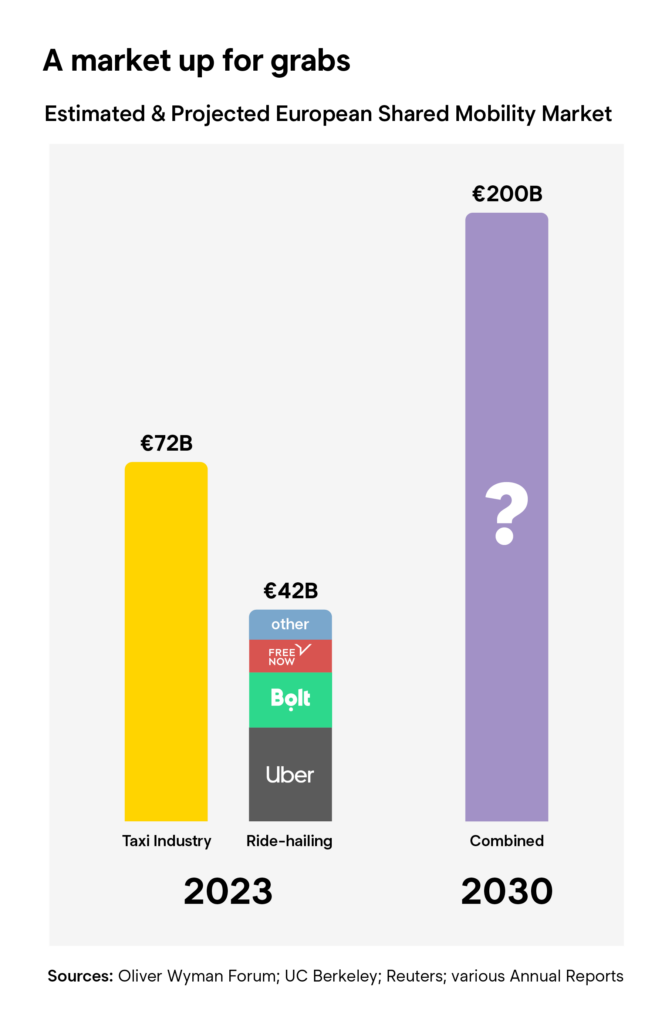
At the same time, the inefficiency of car ownership has come under scrutiny. On average, a car is in motion for only 5% of its life, spending the other 95% parked and underutilised. This inefficiency underscores the potential of shared mobility models, which allow for better utilisation of vehicles and public real estate while addressing consumer demand for flexibility. The rise of the shared mobility market—including car-sharing, subscriptions, and fleet rentals—is poised to reach €200 billion by 2030, marking a fundamental transformation in how vehicles are used and monetised. 

Diversify to Drive Growth 

For dealerships and rental companies, this transformation offers a lifeline. The infrastructure is already there—networks of cars, service technicians, customer relationships, and long-standing industry dominance and the social capital that comes with it—but the business model needs to evolve. Shared mobility offers an opportunity to tap into the growing demand for access over ownership. Mobility-as-a-service (MaaS) provides predictable, recurring revenue streams while meeting the needs of younger, digital-first, sustainability-conscious customers. 

Crucially, this shift doesn’t require starting from scratch. Many local operators are well positioned to integrate shared mobility services into their existing operations. Expanding into short-term rentals or flexible fleet offerings allows businesses to do more with the resources they already have. For car dealerships, this might mean partnering with subscription providers or launching their own branded services. For rental companies, it could involve adopting new technologies to streamline operations and enhance user experiences. 

The Time to Act Is Now 

The European car industry is at a crossroads, but local businesses do not need to wait for manufacturers to pave the way. Shared mobility isn’t a threat—it’s an opportunity to get ahead of the curve, reach new customers, and ensure long-term resilience. The future belongs to those who recognise that mobility is changing and act decisively to adapt. 

The next generation of customers is ready. Are you? 


By Matthew Bezzina, eCabs Technologies’ CEO

Will Europe compete in the global ride-hailing revolution?

The case for digitisation and deregulation


In just five years, shared mobility services, including ride-hailing, are projected to account for over 10% of urban trips, signaling a multi-billion-euro opportunity for economic growth and the chance to tackle urban challenges like traffic congestion and pollution.

Yet, the future of Europe’s mobility market stands at a crossroads: will legacy taxi operators embrace digital transformation, or will they be replaced by tech-driven giants like Uber?

The answer hinges on Europe’s willingness to address its over-regulation crisis.

Europe’s Existential Challenge: Grow or Fall Behind

Mario Draghi’s report to the European Commission couldn’t be clearer: Europe is facing an economic reckoning. 

Without a significant increase in productivity growth, the EU’s economy will remain stagnant until 2050, while global competitors surge ahead. French President Emmanuel Macron echoed this alarm, pointing out that Europe’s regulatory burdens and underinvestment have left it trailing behind the US and China​.

Nowhere is this more evident than in the mobility sector.

Regulatory Barriers: Holding Back Mobility

Across Europe, regulations that once protected local taxi operators now stifle innovation. In Sicily, sky-high licensing fees deter new ride-hailing entrants, reducing transport options. France imposes pick-up restrictions that increase wait times for passengers. Spain caps the working hours of ride-hailing drivers, limiting flexibility. In Greece, outdated pricing laws prevent dynamic models that could boost service availability.

While these regulations were created with good intentions, they now harm consumers and choke out competition.

Meanwhile, in the US, deregulation is on the rise, with tech titans like Elon Musk set to influence policy further through the newly announced Department of Government Efficiency (DOGE).

President-elect Donald Trump, with the help of Musk, plans to slash regulations and streamline government operations, potentially accelerating the growth of ride-hailing platforms, posing a greater threat to European operators if they don’t adapt.

VAT in the Digital Age (ViDA): Leveling the Playing Field

But it’s not all bad news for Europe’s taxi operators. The European Commission’s new ViDA initiative offers a promising silver lining. By mandating that platforms like Uber and Bolt collect and remit VAT, this measure targets the price advantages these companies and their operators have long leveraged through tax loopholes.

With more uniform tax compliance, traditional operators will face a more balanced competitive landscape. Remarkably, the measure has gained overwhelming support across the EU, with Estonia—home of Bolt—standing alone in opposition.

These new VAT rules will help narrow the cost gap between legacy operators and ride-hailing giants, while also boosting EU revenues by up to €18 billion annually. By cracking down on tax evasion, Europe is promoting fair competition and helping traditional operators regain their footing in a rapidly evolving market.

An Urgent Wake-Up Call for Legacy Operators

For traditional taxi associations, the message is simple: Europe’s regulatory framework isn’t their saviour—it’s a potential downfall. The reports show that if Europe continues down this path, it will struggle to remain relevant in the global mobility market​.

Legacy operators must embrace technology to modernise and compete on an increasingly levelled playing field with global ride-hailing giants. This means using data-driven platforms to optimise routes, deploying user-friendly apps for seamless bookings, and improving customer experience to match the expectations of a digital-first generation.

A Balanced Path Forward: Regulation for Innovation

Europe stands at a crucial inflection point. The key is not to abandon regulation but to reform it. Regulation that promotes fair competition and eliminates tax evasion, as seen with ViDA, is essential.

Yet, regulation that enforces outdated business practices must be rethought. A unified, fair, and future-proof regulatory framework could attract investment, spur innovation, and drive sustainable economic growth across the shared mobility landscape.

Yet, achieving this requires political courage and a commitment to reform.

Without swift action, Europe risks falling further behind, costing billions in lost productivity and economic growth.

The time to act is now. 

The case for modernising Europe’s regulatory approach to ride-hailing has never been stronger. If we fail to rise to this challenge, we risk becoming irrelevant in an increasingly tech-driven world. For traditional taxi operators, the opportunity to adapt and thrive is there—but only if they embrace the future.


By Matthew Bezzina, eCabs Technologies’ CEO


Europe’s shared mobility market is growing 20% annually, to reach €200 billion by 2030 – Uber and co. want it all

How will legacy operators fight back?


If you operate a taxi business or association today, this is what the likes of Uber and other ride-hailing giants don’t want you to know: the combined taxi and ride-hailing sectors are growing 20% every single year. And, by 2030, Europe’s shared mobility market is projected to generate €200 billion in annual revenues.

But, while legacy operators are dreaming of market share and margins of yesteryear, ride-hailing giants are growing faster than you think.

These Trojan Horses are silently sneaking into cities across Europe – luring drivers and taxi operators with promises of ‘low commissions’ and ‘platform partnerships’.

But what they are really doing is robbing legacy operators of everything they have worked so hard to build.

Traditionally, the shared mobility market has been anchored by taxi businesses and associations-regulated, for-hire chauffeured vehicles available through curbside hail, pre-booking, or dispatch. These businesses were and remain the backbone of this sector. If you run one of these operations today, do not make the mistake of believing you are the underdog. Because this is not a David vs Goliath story – not quite.

Sure, many of these large ride-hailing platforms can draw on billions in investor funding, but legacy operators still make up about half of Europe’s shared mobility sector. And, more importantly, you have something that these new rivals don’t. Legacy operators have built fleets of loyal and trustworthy drivers – something platforms need to spend big on to try and win over.

You also have deeply ingrained brand recognition, in some cases built over decades if not even generations. And most of you operate in regulatory environments that were designed around you and your needs.

The Ubers of this world on the other hand? They will do whatever it takes to steal your driver supply. They will weaponise their sleek apps to dazzle riders too. They will deploy sweeping, glitzy marketing and social media campaigns. They will even engage in product placement with streaming services like Netflix, targeting the GenZ and GenAlpha riders and drivers of tomorrow.

All the while, they will bully regulators into redesigning policy frameworks to work for them, and – if possible – against you.

These platforms don’t want a slice – they’re after the whole pie.

Embracing the future

Every year, ride-hailing’s share of the European mobility market grows. And, although traditional operators still have an edge, their life expectancy will hinge on their willingness to adapt to new realities. The past is over. The mobility market of the early 2010s cannot be recreated.

Today, more than ever before, it has become essential for taxi operators to embrace emerging technology. Younger generations expect seamless, user-friendly, app-based experiences. They expect this and just won’t settle for less.

Meanwhile, as car ownership declines and urbanisation continues to rise, the demand for efficient shared mobility solutions will only continue to grow.

Countries are also looking inward for innovation, particularly as the trend of hyper-globalisation has hit the brakes. This, again, presents a significant opportunity for homegrown disruption, allowing local operators to innovate and adapt to meet the specific needs of their communities.

A lot is changing. The opportunity to go after this €200 billion market is wide open.

It’s time for legacy operators to fight fire with fire – to become the innovators leading the future of shared mobility. But to do this, they need to invest in the future – in cutting-edge technology, operational horsepower, and industry-leading talent. You can do all this while still holding on to your brand, your autonomy, and without having to hand over the steering wheel.

The industry is growing. Are you?


By Matthew Bezzina, eCabs Technologies’ CEO

eCabs Technologies CEO tells UN body of ‘sandboxing’ opportunities in Malta

Matthew Bezzina spoke at the recent Global Innovation Forum.


Malta presents the perfect sandbox to test tech start ups, but scaling internationally is where the real challenge begins, eCabs Technologies CEO Matthew Bezzina told a United Nations event.

Speaking at the Global Innovation Forum last month, Bezzina weighed in on the complexities of scaling a business initiated in a small market, but said that given its seasonality, small size, and dynamic market, Malta is a perfect destination to test new technology solutions.

“For context, eCabs launched 15 years ago, the same year Uber started in the US and five years before Bolt. Sandboxing in Malta was perfect for us as we were able to test out ride-hailing technology in urban, suburban, and rural settings all at the same time and able to tweak our product in real time,” Bezzina explained.

The same, he said, could be true for other emerging technology in different contexts.

He emphasised that the regulatory landscape of a small, island nation like Malta required tailored solutions that did not always align with approaches used in more expansive markets.

This, however, proved to be a major asset for the company.

Bezzina said that being forced to have flexibility when designing the eCabs product over the years, positioned him and his team to understand the pain points of operators in diverse markets.

In packing this unique operational understanding, together with their tech, and their insights into marketing and different regulatory contexts, eCabs is now seeking to empower shared mobility companies to embrace digitisation.

Bezzina highlighted that while Malta’s size allowed eCabs to rapidly test and implement new technologies, expanding beyond national borders demanded an entirely different strategy.

“The process involves not only adapting to diverse regulatory requirements but also understanding the cultural and operational nuances of new regions,” he noted.

The forum, hosted by the International Telecommunication Union (ITU) in Malta, gathered global tech leaders to discuss the future of digital transformation and entrepreneurship.

The ITU, headquartered in Geneva, Switzerland, is the UN’s oldest specialised agency and has been connecting the world since 1865.

With a membership comprising 194 Member States and over 1,000 companies, universities, and international organisations, the ITU’s Global Innovation Forum is a hub for exchanging ideas that shape the global tech landscape.

Bezzina was joined by Abi Gooch, the Global Corporate Responsibility Strategy Leader at Ernst & Young, Adma Rahman, Head of Entrepreneurship Innovation Centre, Ministry for Education, Brunei, Rosario Huaranaca Quispe, Generation Connect Youth Envoy, Bolivia, Prof Russel Smith, Director of the Centre for Entrepreneurship and Business Incubation, University of Malta, and Zhuoyong Shi, Generation Connect Youth Envoy, China.

Asked what he felt underpinned the eCabs story, Bezzina said that successful scaling hinges on an agile mindset and a robust foundation built on trust.

“Building trust in a market as compact as Malta gave us the core advantage we needed when approaching larger, more complex markets,” Bezzina remarked.

He credited the lessons learned from navigating Malta’s regulations and customer expectations as instrumental in preparing eCabs for international expansion.

Today eCabs powers successful ride-hailing operations in Malta, as well as Athens, Greece, and Bucharest, Romania, with several other European jurisdictions in the pipeline for 2025.

With more than 450 employees and a quarter of a million rides completed monthly, the company has undergone considerable growth.

For more information visit the eCabs Technologies website.

In the Press:

Times of Malta | Newsbook

eCabs joins EU-wide Taxis 4 Smart Mobility coalition

Pictured: eCabs Technologies’ CEO, Matthew Bezzina (left), and Director of Marketing, Erik Polus.

The group is the leading voice for a sustainable European taxi industry

eCabs Malta has announced it has become a member of the Taxis 4 Smart Mobility coalition, a network of innovative and socially responsible taxi organisations.

T4SM represents the European taxi industry, advocating for sustainable, smart mobility solutions while ensuring local and national regulations reflect the unique needs of communities—whether in small villages or large cities. With members from Austria, Denmark, France, Germany, the Netherlands, and Switzerland, the coalition brings thorough insight into the continent’s taxi sector.

eCabs Founder Matthew Bezzina said he was excited to join a group that is made up of some of the leading operators in Europe to lobby for a more sustainable industry.   

“Joining Taxis 4 Smart Mobility is a natural next step for eCabs, aligning perfectly with our vision for a future where mobility is seamless, sustainable, and technology-driven,” Bezzina said.

“We are committed to playing our part in fostering a smart mobility ecosystem that not only meets the needs of riders and drivers but also contributes positively to the environment and communities in which we operate. That’s because we truly believe that this industry can be a major part of the solution,” he added. 

Coalition Chairperson Gregor Beiner said eCabs was a welcome addition to the Taxis 4 Smart Mobility group. 

“eCabs Malta brings another important and dynamic perspective to the coalition with its innovative approach to smart mobility and deep-rooted commitment to sustainability. We are delighted that they are joining T4SM. We will continue to work together on a sustainable and stable mobility offer for Europe and have gained another important partner in eCabs Malta,” Beiner said.

Bezzina and eCabs Director of Marketing, Erik Polus, will attend the coalition’s upcoming meeting in November, shortly after the European Commission hearings are held in Brussels.

This meeting will discuss how the taxi sector can further contribute to the European Green Deal and the ambitious targets set for reducing carbon emissions by 2030.

The Taxis 4 Smart Mobility coalition’s mission is to ensure that the taxi industry leads by example in sustainable urban transport, contributing to the reduction of emissions and traffic congestion, and enhancing accessibility for all.

Through lobbying efforts and collaboration with policymakers, the coalition pushes for more supportive regulatory frameworks and investment in technologies that can transform the industry.

The eCabs announcement comes after Bezzina was among the international speakers at Europe’s leading taxi and transport conference earlier this year.

The European Radio Taxi Association conference brings together prominent figures from the taxi and transport industry across Europe, providing a platform for sharing insights, discussing challenges, and exploring the future of urban mobility.

Speaking during the ERTA conference, held in Düzce, Turkey, Bezzina recalled the eCabs journey over the years.

As a bootstrapped start-up successfully competing with global brands across several EU markets, eCabs has transitioned from a small traditional taxi operator to an app developer empowering fellow operators across Europe to successfully compete against global ride-hailing brands like Bolt and Uber. 

eCabs Technologies, the tech arm of the group, is responsible for developing the proprietary technology that powers the eCabs platform in Malta as well as other ride-hailing operations across Europe. 

New ride-hailing ventures in Bucharest, Romania, and Athens, Greece were launched earlier this year, with projects in other jurisdictions set to launch in the coming months. 

Meanwhile, with his extensive background in marketing and growth, having previously been engaged at Beat (part of FreeNow), Erik Polus said eCabs Technologies is on a mission to empower the taxi industry to successfully compete in the digital age.

“eCabs Technologies has a scalable and competitive ride-hailing tech offering, including rider and driver apps, and a suite of tools for operators, fleet owners, and company managers,” he said.

“We can safely say our solution is proven to be scalable and competitive as we use our tech stack every day to run our business in Malta, a business which includes one of the largest owned and operated fleets in the country, as well as thousands of partner drivers, and a 24/7 call and booking centre.”

“We have built the tools and developed the industry knowledge to partner with businesses that are seeking to not only survive but to thrive against ride-hailing giants,” he said. 


In the Press: Times of Malta | Malta Today | The Malta Independent


The innovator’s dilemma: Legacy taxi operators vs Uber

The last of the taxi roof lights are flickering out, and their once-buzzing dispatchers’ radios are falling silent. Across Europe and beyond, long-standing legacy taxi operations face a formidable challenger: ride-hailing applications like Bolt and Uber are sweeping through every market, in every jurisdiction, gobbling up riders and drivers alike.

Contrary to what you might read elsewhere, legacy taxi businesses do not face an uncertain future. They face a clear and inevitable reality: ride-hailing is here to stay. The critical question as the rides industry continues to grow year-on-year is not if traditional taxi businesses will survive but who will take the largest slice of the pie: disruptors or traditional operators?

The dangers of complacency

Fifteen years ago, eCabs was born as a traditional dial-a-cab business. Like most legacy taxi businesses, we manually registered bookings and dispatched rides from our bookings office. I remember those days—passengers queuing outside our dispatch centre after a night out, drivers waiting idly for their turn to be called on the tannoy.

However, we founded eCabs with the intent to digitize our rides service. We built our own digital platform, on bare metal infrastructure, with all the complications that come with it. We’ve experienced the tricky transition from one system to another—patches upon patches, and late-night scrambling to get back online. All the while, we were competing against the largest ride-hailing platform in the region, Bolt.

Over the years, I’ve learned that disruption can come in pitter-patter, showers, or torrential downpours. In Malta, it was a deluge. After Bolt, came Uber. Today, eCabs is the only locally grown ride-hailing operation in its home market, with other businesses in different jurisdictions running on our platform. This success stems from our continuous investment in our digital offering, from partnering with global leaders like the Google Maps Mobility Platform to headhunting talent from leading ride-hailing tech players.

Facing the real threat

What we’ve learned is that the greatest threat traditional taxi businesses face today isn’t innovation and disruption; it’s the temptation to ignore transformative change. The danger is in burying heads in the sand, hoping ride-hailing tech will simply go away. Take it from me—it won’t. These giants are coming for the traditional taxi businesses, and the answer isn’t in ignoring the change but embracing it.

Legacy operators must become disruptors themselves if they want to survive. Harvard Business School professor Clayton Christensen introduced the concept of the Innovator’s Dilemma in 1997, explaining how established companies often focus on sustaining innovations—incremental improvements to existing products—at the expense of recognizing disruptive innovations on the horizon. These major changes may initially serve niche markets, but they have the power to redefine entire industries.

For legacy taxi businesses, the disruption came in the form of ride-hailing apps. Ignoring these innovations is a recipe for obsolescence. As Uber’s own CEO Dara Khosrowshahi said nearly seven years ago: “If you don’t disrupt yourself, someone else will.”

How to fight back

Digital transformation isn’t a button you press; it’s a process. What eCabs has developed isn’t just a white-label patch for legacy businesses trying to add a digital component to their service. We’ve packed 15 years of hands-on industry expertise into a platform built from real-world experience—competing against global ride-hailing giants, managing fleets, developing data-driven rider marketing campaigns, and educating policymakers.

This isn’t a first aid kit for traditional businesses; it’s a journey for operators who want to become regional leaders in mobility. Because make no mistake, global ride-hailing platforms aren’t coming for a piece of the pie—they want the entire thing.


By Matthew Bezzina, eCabs Technologies CEO


Matthew Bezzina will be a key speaker at the upcoming Start-Up Festival in Malta. The festival brings together entrepreneurs, investors, and enthusiasts to explore cutting-edge technologies, disruptive business models, and groundbreaking solutions. A highlight is the “Dream Big Malta” panel, celebrating the achievements of individuals from Malta excelling in international business, professions, or sports.

The original article may be found here.