A Frankfurt-based taxi dispatch centre is shifting its live operations to technology developed by Malta-based eCabs Technologies.
eCabs announced its new strategic partnership with Taxi Now Frankfurt in a statement on Monday.
Taxi Now Frankfurt will be migrating its existing live business to the eCabs platform and timelines for the migration will depend on several factors, including ride volumes and the depth of systems integrations.
Germany’s taxi market is still heavily reliant on offline booking methods such as phone dispatch, radio calls, taxi ranks, hotels and streetside cab hailing, which account for 70 per cent of all demand.
eCabs believes the market is “under digitalised” and ripe for disruption.
“Germany is one of the most operationally demanding mobility markets in Europe,” eCabs Technologies CEO Matthew Bezzina said.
“Successfully onboarding a live dispatch centre like Taxi Now is certainly a commercial win, but it is also an important proof point that our platform can indeed meet the highly challenging regulatory, technical and operational requirements of one of the continent’s most complex mobility environments.”
Bezzina said the deal with Taxi Now follows a multi-year investment into a Germany-focused commercial team that includes German-speaking support and operations teams.
eCabs Technologies also invested in product development tailored to German regulatory requirements, including taximeter integrations, tax authority interfaces, healthcare transport systems, and public transport infrastructure links.
Celestyn Pfaffl, Owner of Taxi Now Frankfurt owner Meycar GmbH, said the company had weighed its decision to migrate a live operation heavily/
“We were looking for a technology partner that understands the operational realities of the German taxi market, not just generic ride-hailing use cases. eCabs Technologies demonstrated both the technical maturity and the long-term product vision we believe are necessary to future-proof our business,” he said.
The eCabs Technologies ride-hailing platform is now active in Malta; Athens (Greece); Bucharest and Brașov (Romania); Berlin and Frankfurt (Germany); Bristol (UK); and Esperance (Australia). The company says it will be announcing another city launch in the Nordics this year.
eCabs Technologies is the tech arm of eCabs Mobility, a ride-hailing platform focused on the Maltese market. The company offers white-label SaaS tech platforms for mobility operators across the globe.
https://ecabstech.com/wp-content/uploads/2026/01/ecabs-frankfurt.jpeg600800m7alphahttps://ecabstech.com/wp-content/uploads/2024/08/eCabs_tect_logo_dark.svgm7alpha2026-01-28 14:29:052026-01-28 14:29:05eCabs Technologies strikes deal to enter German market though Taxi Now Frankfurt
eCabs Technologies offers marketing and driver tools that enable traditional taxi dispatch centres to secure and expand their market share.
The taxi industry is under pressure. Platform operators such as Uber, Bolt and Freenow are luring both passengers and drivers away from established dispatch centres with aggressive discounts. Yet a Maltese technology company is demonstrating that the battle is far from lost: eCabs Technologies has developed an integrated software package that puts the same weapons into the hands of taxi dispatch centres that the global platforms have used to conquer the market – and in key areas, even surpasses them.
From Taxi Dispatch Centre Operator to Technology Provider
eCabs Technologies is not a conventional software manufacturer. The company itself operates the largest independent taxi dispatch centre in Malta – in direct competition with Uber and Bolt. This experience from day-to-day operations fed directly into the development of the dispatch software. “We built the tools we needed ourselves to hold our own against the global platforms,” is how the company describes its approach.
The result is a system that brings together two worlds that were previously separate: targeted customer acquisition and retention on the one hand, and intelligent driver management on the other. Both areas interlock and create a cycle that both stimulates demand and reliably secures supply.
Passenger campaigns: precision instead of scattergun tactics
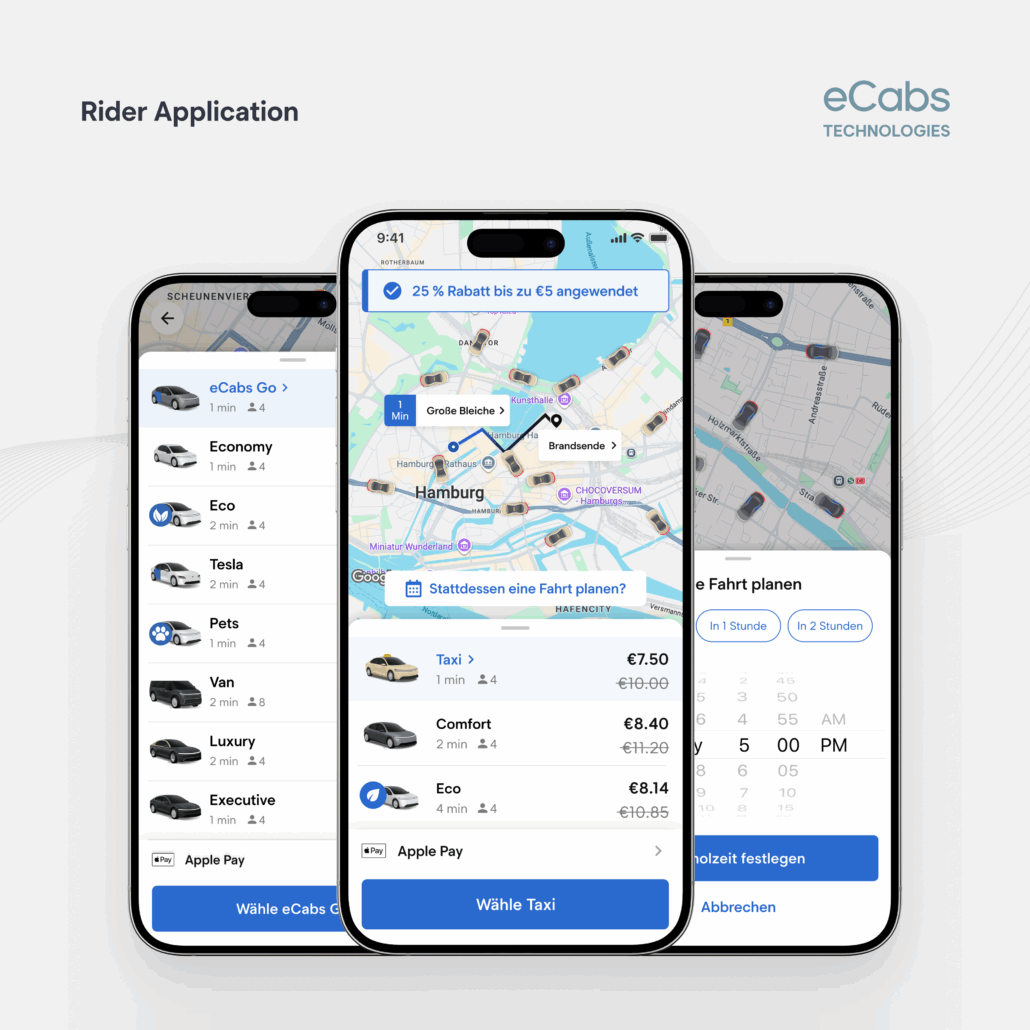
At the heart of the customer strategy is multi-level segmentation. The software distinguishes, for example, between frequent local passengers, tourists with different lengths of stay, business travellers and nightlife users. Each segment receives individually tailored offers.
In Malta, eCabs implemented a distinction between local users (identified via Maltese telephone numbers) and tourists (foreign dialling codes). Local regular customers receive loyalty bonuses, while short-stay visitors receive time-coordinated reminders for return journeys to the airport. The result: the rebooking rate among short-stay tourists increased by 19 per cent.
Another example from Bucharest shows the economic efficiency of this approach: during a summer campaign, trip volume rose by 14 per cent and revenue by 9 per cent. At the same time, marketing costs per conversion fell by 20 per cent – thanks to fraud-proof vouchers that prevent misuse.
The platform offers taxi dispatch centres three ways of controlling promotions: an integrated customer engagement platform for multi-channel communication, a promotions engine for automated discounts and loyalty programmes, and an in-house promotion tool that dispenses with external providers. The latter reduced the set-up time for campaigns in Greece from three days to 15 minutes – resulting in 8 per cent more trips on campaign days without exceeding the budget.
Multi-channel orchestration: full control without a marketing agency
The customer retention tool goes far beyond simple discount codes. At its core is an orchestration platform that controls all communication channels from a single central interface.
Push notifications can be played out individually and in a targeted way directly in the passenger app. Unlike mass mailings, the message reaches precisely the passenger who is receptive to a specific offer at that moment – for example, the business traveller who regularly travels to the airport on Fridays, or the night owl who books a journey home at 2 a.m. on Saturdays.
In parallel, the system enables automated campaigns across various social media channels. The taxi dispatch centre defines target groups, time windows and budget limits – the tool takes care of delivery and automatically stops as soon as the defined budget has been reached. No nasty surprises at the end of the month, no uncontrolled spending.
The key advantage lies in orchestration: a taxi dispatch centre can run different campaigns with different rules at the same time – for example, a loyalty bonus for regular customers via push notifications, new customer acquisition via social media and a reactivation campaign for churned users via e-mail. The system coordinates all activities, prevents overlaps and provides the status and results of each individual campaign in real time.
For taxi dispatch centres, this means full cost control with maximum reach. No external marketing agency is required to run professional campaigns. This saves not only money but also time – and enables rapid reactions to market changes.
eCabs Technologies goes one step further: the company actively trains its customers in how to use the tool. Instead of selling software and then leaving the user to get on with it, eCabs imparts the know-how for targeted use. Taxi dispatch centres learn which types of campaign are suitable for which situations, how to sensibly segment their target groups and how to draw the right conclusions from real-time data. The software thus becomes not just a tool but a strategic competitive advantage.
The driver app as a strategic instrument
The real breakthrough, however, lies in linking customer marketing with driver management. After all, even the best advertising campaign comes to nothing if no driver is available at the time of booking. eCabs Technologies addresses this problem with a comprehensive incentive system for drivers.
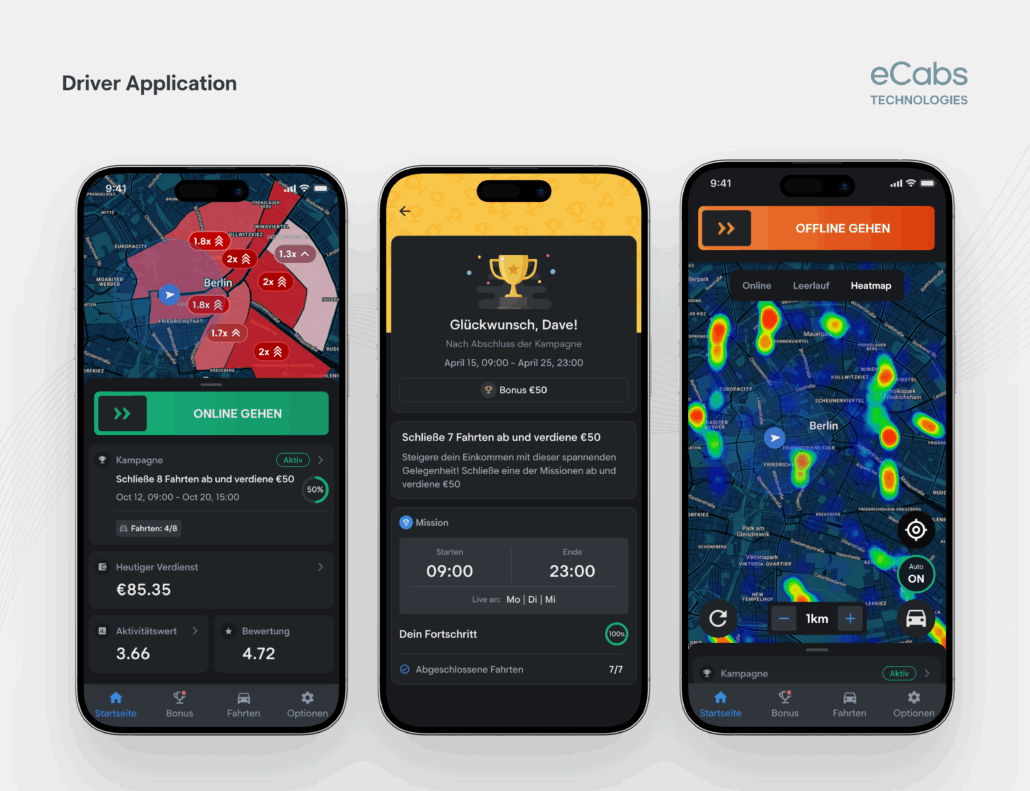
The system works with time-limited, target-based campaigns. A typical example: “Complete ten trips, receive a 20-euro bonus.” Payout is automatic and immediate. In the driver app, drivers can see their progress in real time – a gamification element that demonstrably increases motivation.
The effect is measurable. In Romania, completed trips increased by 12 per cent within six weeks. In Greece, reliability at peak times improved by 8 per cent through weekend incentives. In Australia, campaign-related income per driver increased by 14.67 per cent.
Activity Score: the end of cancellations
A central problem for taxi dispatch centres is drivers who accept jobs and then cancel at short notice – for example because they are simultaneously logged in with Uber or Bolt and are waiting for more lucrative trips. eCabs Technologies counters this phenomenon with the so-called Activity Score.
The score is based on a driver’s last 40 trips and measures their reliability in real time. If the value falls below a defined threshold, an automatic temporary suspension is triggered. The results in Malta speak for themselves: the cancellation rate fell from 14 to 6 per cent. At the same time, availability at peak times rose by 19 per cent.
Surge pricing: directing drivers to where they are needed
The system also includes dynamic price adjustments in high-demand zones. Unlike the global platforms, where surge pricing primarily serves to maximise revenue, eCabs uses this instrument as a control mechanism for fleet distribution.
The driver app shows zones with increased fares on a map, along with the respective multiplier. This motivates drivers to move to where they are actually needed. In Malta, the introduction of surge zones in Sliema, St Julian’s and Valletta with a 1.5 multiplier led to the following results: drivers’ active online hours increased by 18 per cent, the acceptance rate by 9 per cent and the completion rate during peak times by 7 per cent.
Why drivers stay with the dispatch centre
The key question for taxi dispatch centres is: why should a driver accept jobs from me if they are simultaneously registered with Uber, Bolt and Freenow? eCabs Technologies provides several answers.
Firstly: transparent and immediately available bonuses. Whereas with platform operators it is often unclear when and whether incentives will kick in, an eCabs driver can see their progress and the expected bonus in real time.
Secondly: the one-tap acceptance function reduces the time between job offer and acceptance. In Australia, the acceptance rate increased by 9 per cent and average response time shortened by 7 seconds. Faster acceptance means more trips per hour.
Thirdly: the auto-accept function enables drivers to accept the next trip automatically. This maximises utilisation and reduces idle time – a direct income advantage.
Fourthly: the heatmap function shows in real time where there is demand and where drivers are active or idle. In Romania, idle times fell by 31 per cent, while coverage in high-demand zones increased by 27 per cent.
The overall calculation for Malta
The Maltese home market of eCabs Technologies serves as a trial by fire. Here the company competes daily against Uber and Bolt for a limited pool of passengers and drivers. The combined strategy of customer segmentation, targeted promotions, driver incentives and intelligent fleet management has led to a measurable result: driver churn during the critical summer season fell by 25 per cent.
This figure illustrates the true core of the system: it is not just about winning customers or motivating drivers. It is about keeping both sides of the marketplace in balance. A loyalty programme without available drivers results in disappointed customers. Driver incentives without demand fizzle out without effect. Only the integration of both sides creates a self-reinforcing cycle.
The roadmap: from today to AI optimisation
eCabs Technologies is continuously developing the system further. The current roadmap shows three stages of development:
By the end of 2025, the focus will be on consolidating the core functions: fixed discount amounts, manual activation, usage limits and real-time reporting. Even now, operators can set up campaigns independently within a few minutes.
For 2026, expansion to include percentage discounts, trip and payment filters, target group rules and budget limits is planned. This will enable even more precise campaigns with full cost control.
For 2026 to 2027, the company has announced its entry into AI-supported optimisation: automatic segmentation, referral and loyalty integration, and a budget optimiser that autonomously adapts campaigns to demand and budget specifications.
In parallel, the driver campaign suite is evolving from the current basic version with fixed bonuses, through behaviour-based automation and zone targeting, to AI-controlled offer management that makes recommendations based on real-time demand and individual driver behaviour.
Conclusion: same weapons, better use
The battle between traditional taxi dispatch centres and global platform operators is not a battle between tradition and technology. It is a battle over the better use of data and tools. eCabs Technologies demonstrates that taxi dispatch centres can not only adopt these tools, but can use them even more effectively thanks to their knowledge of local markets and long-standing relationships with drivers.
The results from Malta, Romania, Greece and Australia demonstrate that targeted customer engagement leads to more trips and higher average fares per trip. Intelligent driver incentives lead to drivers generating more revenue and preferring to accept jobs from their taxi dispatch centre. Both sides reinforce each other.
For taxi dispatch centres looking for strategies to counter the market power of Uber, Bolt and Freenow, eCabs Technologies provides a concrete blueprint – developed and tested in its own competitive struggle.
https://ecabstech.com/wp-content/uploads/2025/12/image-80.png16002400erikpolus@ecabs.com.mthttps://ecabstech.com/wp-content/uploads/2024/08/eCabs_tect_logo_dark.svgerikpolus@ecabs.com.mt2025-12-05 13:24:082025-12-05 13:28:10Uber and Bolt: Tools for Fighting Back
Pictured: eCabs Technologies’ CEO, Matthew Bezzina (left), and Director of Marketing, Erik Polus.
The group is the leading voice for a sustainable European taxi industry
eCabs Malta has announced it has become a member of the Taxis 4 Smart Mobility coalition, a network of innovative and socially responsible taxi organisations.
T4SM represents the European taxi industry, advocating for sustainable, smart mobility solutions while ensuring local and national regulations reflect the unique needs of communities—whether in small villages or large cities. With members from Austria, Denmark, France, Germany, the Netherlands, and Switzerland, the coalition brings thorough insight into the continent’s taxi sector.
eCabs Founder Matthew Bezzina said he was excited to join a group that is made up of some of the leading operators in Europe to lobby for a more sustainable industry.
“Joining Taxis 4 Smart Mobility is a natural next step for eCabs, aligning perfectly with our vision for a future where mobility is seamless, sustainable, and technology-driven,” Bezzina said.
“We are committed to playing our part in fostering a smart mobility ecosystem that not only meets the needs of riders and drivers but also contributes positively to the environment and communities in which we operate. That’s because we truly believe that this industry can be a major part of the solution,” he added.
Coalition Chairperson Gregor Beiner said eCabs was a welcome addition to the Taxis 4 Smart Mobility group.
“eCabs Malta brings another important and dynamic perspective to the coalition with its innovative approach to smart mobility and deep-rooted commitment to sustainability. We are delighted that they are joining T4SM. We will continue to work together on a sustainable and stable mobility offer for Europe and have gained another important partner in eCabs Malta,” Beiner said.
Bezzina and eCabs Director of Marketing, Erik Polus, will attend the coalition’s upcoming meeting in November, shortly after the European Commission hearings are held in Brussels.
This meeting will discuss how the taxi sector can further contribute to the European Green Deal and the ambitious targets set for reducing carbon emissions by 2030.
The Taxis 4 Smart Mobility coalition’s mission is to ensure that the taxi industry leads by example in sustainable urban transport, contributing to the reduction of emissions and traffic congestion, and enhancing accessibility for all.
Through lobbying efforts and collaboration with policymakers, the coalition pushes for more supportive regulatory frameworks and investment in technologies that can transform the industry.
The European Radio Taxi Association conference brings together prominent figures from the taxi and transport industry across Europe, providing a platform for sharing insights, discussing challenges, and exploring the future of urban mobility.
Speaking during the ERTA conference, held in Düzce, Turkey, Bezzina recalled the eCabs journey over the years.
As a bootstrapped start-up successfully competing with global brands across several EU markets, eCabs has transitioned from a small traditional taxi operator to an app developer empowering fellow operators across Europe to successfully compete against global ride-hailing brands like Bolt and Uber.
eCabs Technologies, the tech arm of the group, is responsible for developing the proprietary technology that powers the eCabs platform in Malta as well as other ride-hailing operations across Europe.
New ride-hailing ventures in Bucharest, Romania, and Athens, Greece were launched earlier this year, with projects in other jurisdictions set to launch in the coming months.
Meanwhile, with his extensive background in marketing and growth, having previously been engaged at Beat (part of FreeNow), Erik Polus said eCabs Technologies is on a mission to empower the taxi industry to successfully compete in the digital age.
“eCabs Technologies has a scalable and competitive ride-hailing tech offering, including rider and driver apps, and a suite of tools for operators, fleet owners, and company managers,” he said.
“We can safely say our solution is proven to be scalable and competitive as we use our tech stack every day to run our business in Malta, a business which includes one of the largest owned and operated fleets in the country, as well as thousands of partner drivers, and a 24/7 call and booking centre.”
“We have built the tools and developed the industry knowledge to partner with businesses that are seeking to not only survive but to thrive against ride-hailing giants,” he said.
Whether it’s machines or machine learning, we tend to hold technology to impossibly high standards, expecting perfection at every turn. Mistakes made by people are often forgiven, but tech errors? They frustrate us deeply. I understand this firsthand—there’s nothing better than ride-hailing tech that works flawlessly, and few things more irritating than when it doesn’t.
At eCabs Technologies, we acknowledge this reality. That’s why our engineers work hard every day to bridge the gap between technology and the real world. Innovation isn’t just about creating cutting-edge solutions; it’s about ensuring those solutions integrate seamlessly into people’s lives. We believe technology should empower communities, not alienate them.
Sadly, many tech companies have fallen short. Disconnected from the communities they serve, they’ve faced criticism for their lack of diversity and the biases embedded in their systems. Predominantly white, male workforces often fail to account for the varied experiences of the people their products are meant to serve. This gap between intention and execution has led to mistrust in tech.
The impact of this disconnection is far-reaching. Consider facial recognition systems with racial biases, location algorithms that neglect low-income areas, or service options limited to binary gender categories. These issues are not minor inconveniences—they exclude and marginalise people, making them feel unseen, unwelcome, or even discriminated against. When technology fails to reflect the diversity of its users, it fails its mission.
Real people interacting with real people
At eCabs, we do things differently. We’re not just about people interacting with technology—we’re about real people connecting with real people. Our technology is only one piece of a much broader relationship that includes drivers, riders, and urban communities. Our role is to nurture and manage this relationship, ensuring it works for everyone.
Take drivers, for example. To our customers, they are the human face of a business that otherwise exists primarily through a digital interface. That’s why we’ve built a dedicated team of developers to create technology that truly supports drivers. From ensuring our payment systems are stable and reliable—because we know how critical that income is—to designing tools that make their jobs easier, we’re committed to their success.
Our commitment doesn’t end there. We regularly engage with our partner drivers to understand their day-to-day experiences. We ask questions like, “How much information is too much for someone who needs to keep their eyes on the road?” These conversations guide us in refining our technology, ensuring it meets the real-world needs of those who depend on it most.
Part of the solution
eCabs also actively engages with the communities we operate in. Whether we’re working with local leaders to green urban spaces or collaborating with national regulators to improve traffic flow, we’re committed to being part of the solution.
When we say we’re part of the solution, we mean it. We’re constantly looking for better ways to connect drivers and riders with the urban areas they navigate. By optimizing routes and enhancing journey experiences, we aim to improve the lives of everyone using our service—drivers and riders alike.
Because at eCabs Technologies, we know our technology doesn’t exist in a vacuum. It operates in the real world, and it’s our responsibility to ensure it serves the real people who rely on it every day.