Uber and Bolt: Tools for Fighting Back
eCabs Technologies offers marketing and driver tools that enable traditional taxi dispatch centres to secure and expand their market share.
The taxi industry is under pressure. Platform operators such as Uber, Bolt and Freenow are luring both passengers and drivers away from established dispatch centres with aggressive discounts. Yet a Maltese technology company is demonstrating that the battle is far from lost: eCabs Technologies has developed an integrated software package that puts the same weapons into the hands of taxi dispatch centres that the global platforms have used to conquer the market – and in key areas, even surpasses them.
From Taxi Dispatch Centre Operator to Technology Provider
eCabs Technologies is not a conventional software manufacturer. The company itself operates the largest independent taxi dispatch centre in Malta – in direct competition with Uber and Bolt. This experience from day-to-day operations fed directly into the development of the dispatch software. “We built the tools we needed ourselves to hold our own against the global platforms,” is how the company describes its approach.
The result is a system that brings together two worlds that were previously separate: targeted customer acquisition and retention on the one hand, and intelligent driver management on the other. Both areas interlock and create a cycle that both stimulates demand and reliably secures supply.
Passenger campaigns: precision instead of scattergun tactics
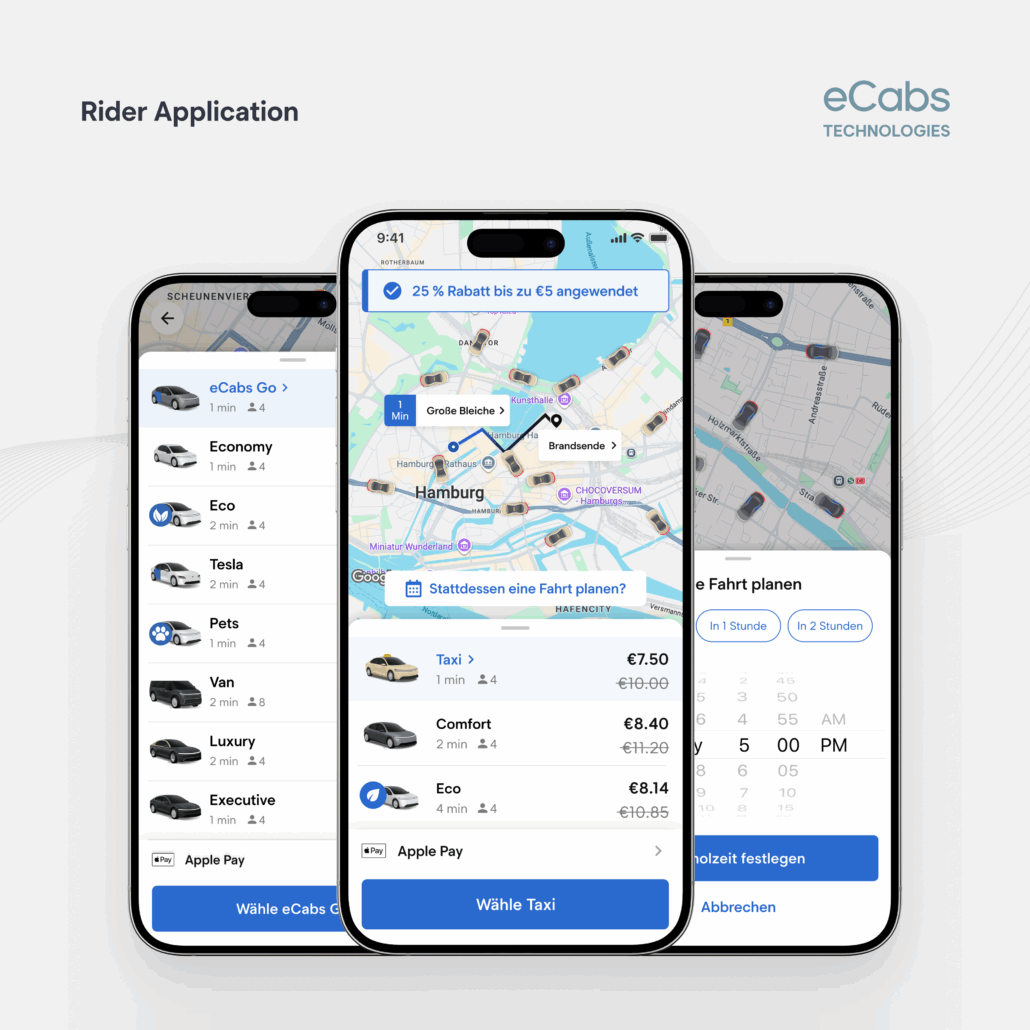
At the heart of the customer strategy is multi-level segmentation. The software distinguishes, for example, between frequent local passengers, tourists with different lengths of stay, business travellers and nightlife users. Each segment receives individually tailored offers.
In Malta, eCabs implemented a distinction between local users (identified via Maltese telephone numbers) and tourists (foreign dialling codes). Local regular customers receive loyalty bonuses, while short-stay visitors receive time-coordinated reminders for return journeys to the airport. The result: the rebooking rate among short-stay tourists increased by 19 per cent.
Another example from Bucharest shows the economic efficiency of this approach: during a summer campaign, trip volume rose by 14 per cent and revenue by 9 per cent. At the same time, marketing costs per conversion fell by 20 per cent – thanks to fraud-proof vouchers that prevent misuse.
The platform offers taxi dispatch centres three ways of controlling promotions: an integrated customer engagement platform for multi-channel communication, a promotions engine for automated discounts and loyalty programmes, and an in-house promotion tool that dispenses with external providers. The latter reduced the set-up time for campaigns in Greece from three days to 15 minutes – resulting in 8 per cent more trips on campaign days without exceeding the budget.
Multi-channel orchestration: full control without a marketing agency
The customer retention tool goes far beyond simple discount codes. At its core is an orchestration platform that controls all communication channels from a single central interface.
Push notifications can be played out individually and in a targeted way directly in the passenger app. Unlike mass mailings, the message reaches precisely the passenger who is receptive to a specific offer at that moment – for example, the business traveller who regularly travels to the airport on Fridays, or the night owl who books a journey home at 2 a.m. on Saturdays.
In parallel, the system enables automated campaigns across various social media channels. The taxi dispatch centre defines target groups, time windows and budget limits – the tool takes care of delivery and automatically stops as soon as the defined budget has been reached. No nasty surprises at the end of the month, no uncontrolled spending.
The key advantage lies in orchestration: a taxi dispatch centre can run different campaigns with different rules at the same time – for example, a loyalty bonus for regular customers via push notifications, new customer acquisition via social media and a reactivation campaign for churned users via e-mail. The system coordinates all activities, prevents overlaps and provides the status and results of each individual campaign in real time.
For taxi dispatch centres, this means full cost control with maximum reach. No external marketing agency is required to run professional campaigns. This saves not only money but also time – and enables rapid reactions to market changes.
eCabs Technologies goes one step further: the company actively trains its customers in how to use the tool. Instead of selling software and then leaving the user to get on with it, eCabs imparts the know-how for targeted use. Taxi dispatch centres learn which types of campaign are suitable for which situations, how to sensibly segment their target groups and how to draw the right conclusions from real-time data. The software thus becomes not just a tool but a strategic competitive advantage.
The driver app as a strategic instrument
The real breakthrough, however, lies in linking customer marketing with driver management. After all, even the best advertising campaign comes to nothing if no driver is available at the time of booking. eCabs Technologies addresses this problem with a comprehensive incentive system for drivers.
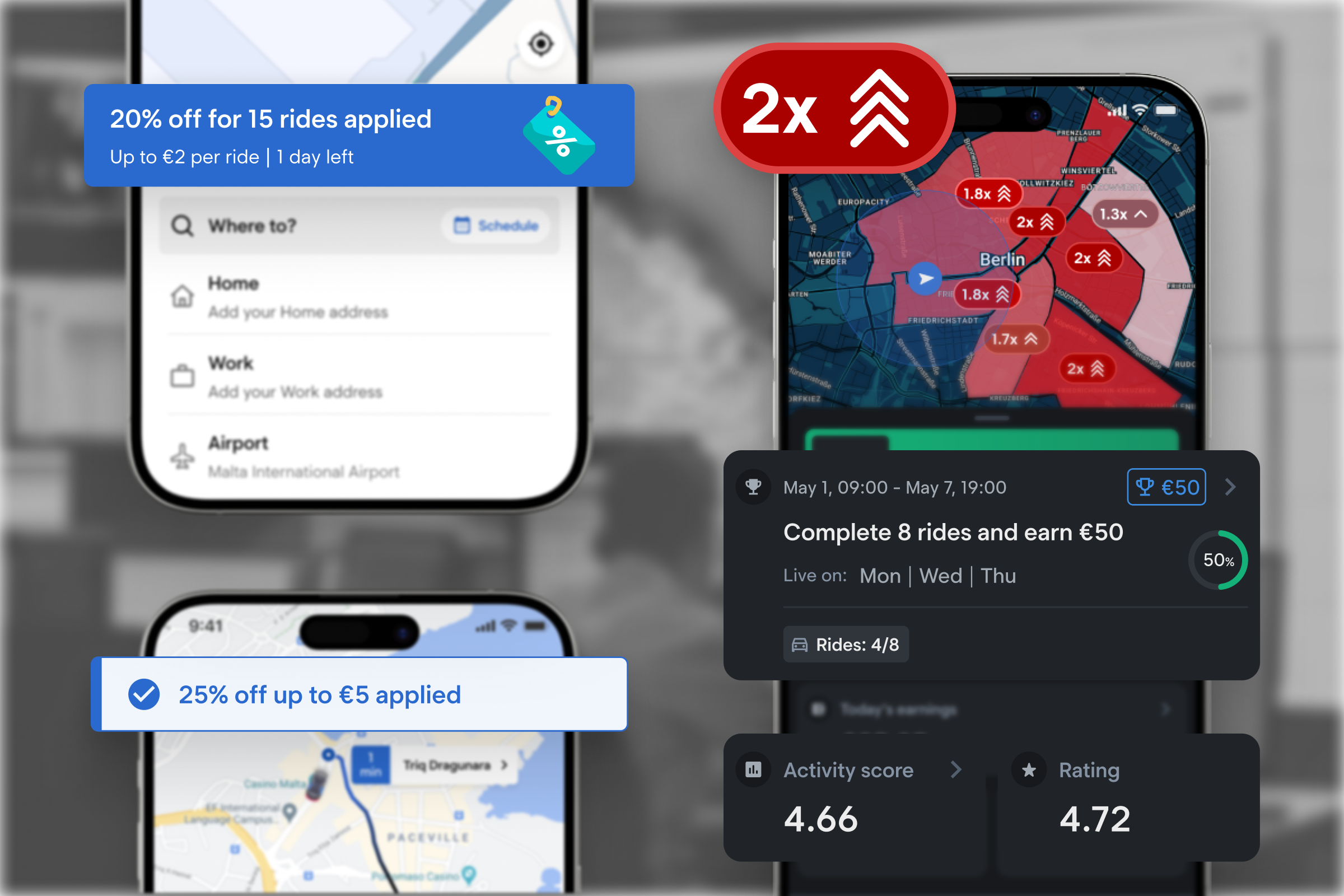
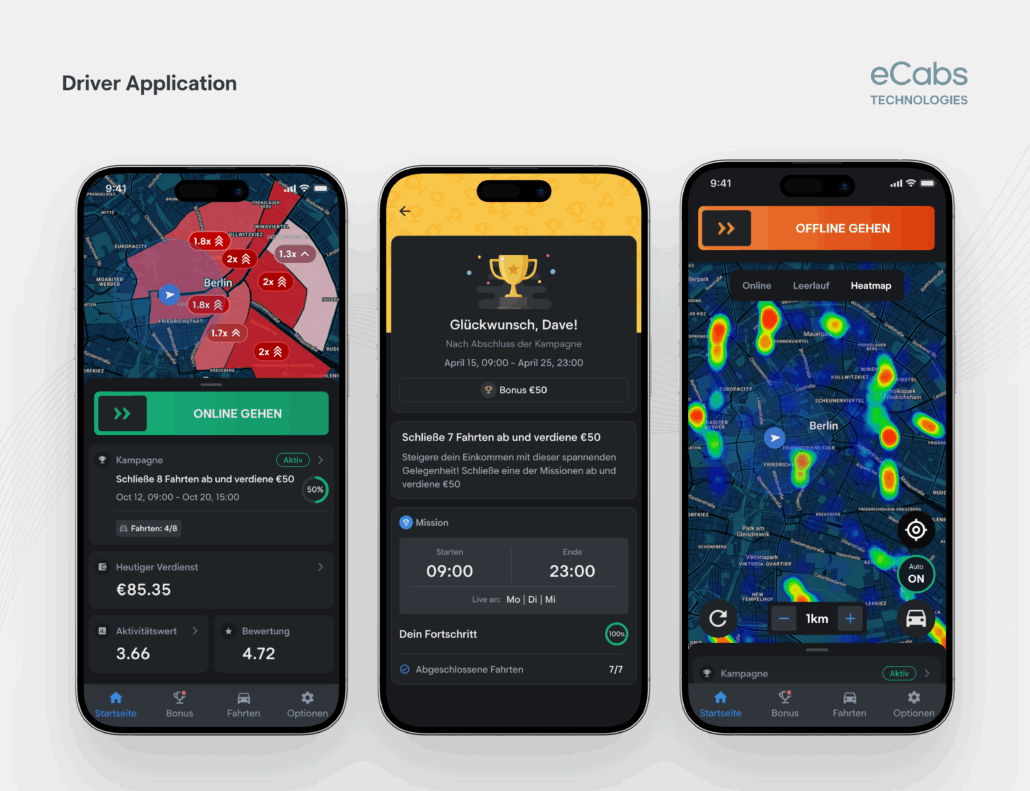
The system works with time-limited, target-based campaigns. A typical example: “Complete ten trips, receive a 20-euro bonus.” Payout is automatic and immediate. In the driver app, drivers can see their progress in real time – a gamification element that demonstrably increases motivation.
The effect is measurable. In Romania, completed trips increased by 12 per cent within six weeks. In Greece, reliability at peak times improved by 8 per cent through weekend incentives. In Australia, campaign-related income per driver increased by 14.67 per cent.
Activity Score: the end of cancellations
A central problem for taxi dispatch centres is drivers who accept jobs and then cancel at short notice – for example because they are simultaneously logged in with Uber or Bolt and are waiting for more lucrative trips. eCabs Technologies counters this phenomenon with the so-called Activity Score.
The score is based on a driver’s last 40 trips and measures their reliability in real time. If the value falls below a defined threshold, an automatic temporary suspension is triggered. The results in Malta speak for themselves: the cancellation rate fell from 14 to 6 per cent. At the same time, availability at peak times rose by 19 per cent.
Surge pricing: directing drivers to where they are needed
The system also includes dynamic price adjustments in high-demand zones. Unlike the global platforms, where surge pricing primarily serves to maximise revenue, eCabs uses this instrument as a control mechanism for fleet distribution.
The driver app shows zones with increased fares on a map, along with the respective multiplier. This motivates drivers to move to where they are actually needed. In Malta, the introduction of surge zones in Sliema, St Julian’s and Valletta with a 1.5 multiplier led to the following results: drivers’ active online hours increased by 18 per cent, the acceptance rate by 9 per cent and the completion rate during peak times by 7 per cent.
Why drivers stay with the dispatch centre
The key question for taxi dispatch centres is: why should a driver accept jobs from me if they are simultaneously registered with Uber, Bolt and Freenow? eCabs Technologies provides several answers.
Firstly: transparent and immediately available bonuses. Whereas with platform operators it is often unclear when and whether incentives will kick in, an eCabs driver can see their progress and the expected bonus in real time.
Secondly: the one-tap acceptance function reduces the time between job offer and acceptance. In Australia, the acceptance rate increased by 9 per cent and average response time shortened by 7 seconds. Faster acceptance means more trips per hour.
Thirdly: the auto-accept function enables drivers to accept the next trip automatically. This maximises utilisation and reduces idle time – a direct income advantage.
Fourthly: the heatmap function shows in real time where there is demand and where drivers are active or idle. In Romania, idle times fell by 31 per cent, while coverage in high-demand zones increased by 27 per cent.
The overall calculation for Malta
The Maltese home market of eCabs Technologies serves as a trial by fire. Here the company competes daily against Uber and Bolt for a limited pool of passengers and drivers. The combined strategy of customer segmentation, targeted promotions, driver incentives and intelligent fleet management has led to a measurable result: driver churn during the critical summer season fell by 25 per cent.
This figure illustrates the true core of the system: it is not just about winning customers or motivating drivers. It is about keeping both sides of the marketplace in balance. A loyalty programme without available drivers results in disappointed customers. Driver incentives without demand fizzle out without effect. Only the integration of both sides creates a self-reinforcing cycle.
The roadmap: from today to AI optimisation
eCabs Technologies is continuously developing the system further. The current roadmap shows three stages of development:
By the end of 2025, the focus will be on consolidating the core functions: fixed discount amounts, manual activation, usage limits and real-time reporting. Even now, operators can set up campaigns independently within a few minutes.
For 2026, expansion to include percentage discounts, trip and payment filters, target group rules and budget limits is planned. This will enable even more precise campaigns with full cost control.
For 2026 to 2027, the company has announced its entry into AI-supported optimisation: automatic segmentation, referral and loyalty integration, and a budget optimiser that autonomously adapts campaigns to demand and budget specifications.
In parallel, the driver campaign suite is evolving from the current basic version with fixed bonuses, through behaviour-based automation and zone targeting, to AI-controlled offer management that makes recommendations based on real-time demand and individual driver behaviour.
Conclusion: same weapons, better use
The battle between traditional taxi dispatch centres and global platform operators is not a battle between tradition and technology. It is a battle over the better use of data and tools. eCabs Technologies demonstrates that taxi dispatch centres can not only adopt these tools, but can use them even more effectively thanks to their knowledge of local markets and long-standing relationships with drivers.
The results from Malta, Romania, Greece and Australia demonstrate that targeted customer engagement leads to more trips and higher average fares per trip. Intelligent driver incentives lead to drivers generating more revenue and preferring to accept jobs from their taxi dispatch centre. Both sides reinforce each other.
For taxi dispatch centres looking for strategies to counter the market power of Uber, Bolt and Freenow, eCabs Technologies provides a concrete blueprint – developed and tested in its own competitive struggle.
Ride-hailing tech
Engineered for Ambition.
Related News